 Prepared by residents and fellows, this handy consult reference covers the full spectrum of infectious disease problems. It offers clinicians valuable assistance in determining what infections the patient is at risk for, where and how (s)he acquired the infection, how to evaluate and manage the patient, and what complications to expect. Information on infections of each organ system includes an approach to that organ system. Other topics covered include bioterrorism, sexually transmitted diseases, brucellosis, systemic mycoses, immunizations, and antimicrobials. |
Wednesday, June 29, 2005
The Washington Manual® Infectious Diseases Subspecialty Consult
Skyscape has released The Washington Manual® Infectious Diseases Subspecialty Consult 8.0.3:
Sunday, June 26, 2005
Breast Ca,
Dr. Harvey Katzen has suggested I add in the Gail Breast Ca. model to Haemoncrules but after looking at Philip Cheng's excellent freeware BreastCa 1.0, I don't think I could do better!
 BreastCa is a breast cancer risk prediction tool for the Palm Computing Platform. In particular, it is designed to be a fast, easy-to-use, and accurate implementation of two commonly-used models of breast cancer risk prediction: the Gail and Claus models. |
Haemoncrules 1.9
 Version 1.9 has been updated in Palmgear.
What's new:
- the MDS prognostic score had an error as pointed out
by Dr Ivanov Vadim of Institut Paoli-Calmettes,
Marseilles. This has been corrected.
- added a Febrile Neutropenia Risk module.
For more details (version history, list of modules etc.) please visit the HaemOncRules Homepage
I have also made some changes to the HaemOncRules homepage, listing instructions for Pocket PC users who wish to run HaemOncRules on a Windows Mobile device.
Friday, June 24, 2005
Oxford Handbook of Clinical Medicine, 6th Ed.
Skyscape has released the Oxford Handbook of Clinical Medicine, 6th Ed.
While Harrison's may be the popular General medicine reference in North America, across the pond, it's the Oxford Handbook of Clinical Medicine. Glad to see it updated in Skyscape
 Description: The Oxford Handbook of Clinical Medicine covers all areas of internal medicine and provides rapid, on-the-spot access to evidence-based clinical management. Its characteristic style - combining incisive guidance with wit, a lucid style, and memorable epigrams - has been popular with generations of medical students and junior doctors the world over. There are a host of new features in this edition: new sections on common acute medical symptoms, and clinical skills; a new 'cheat sheet' on commonly used drugs; and more ECGs. There are numerous other updates and improvements throughout, many suggested by extensive market research. A new junior co-author has ensured that the text is just right for its market and tells medicine 'as it is'; and a panel of senior readers has approved every section. The Oxford Handbook of Clinical Medicine is an utterly reliable 'friend in the pocket', any time of the day or night! |
While Harrison's may be the popular General medicine reference in North America, across the pond, it's the Oxford Handbook of Clinical Medicine. Glad to see it updated in Skyscape
Valuable lessons
Skyscape has user story in Valuable lessons from an oncologist who maximizes learning with a Palm
How many times have I looked up references in front of patients now using the PDA. I think this is not only "more acceptable" as Dr. Cartwright puts it, it is far less embarassing! Moreover, using a PDA still has a "wow" factor which impresses patients.
Also spotted in MobileHealthData: Hand-held Takes Physician to School
So have you found the Epocrates MobileCME service useful? I have. Hopefully my local CME organiser will accept the Epocrates MobileCME points.
| I have used Griffith's 5-Minute Clinical Consult 2005 since I was an Intern, and now as a 2nd year oncology fellow, I have been using AJCC Cancer Staging Handbook & Calculator and Physicians' Cancer Chemotherapy Drug Manual 2005 constantly. Having the resources instantly accessible to me while seeing patients has helped teach me more treatments and staging that I otherwise wouldn't have learned. Taking out a book in front of a patient is not quite as acceptable as quickly looking down at my Palm for the answer. Having the resources at my fingertips has definitely helped make me a better doctor, and as a visual learner, helped me learn more quickly. My textbooks are back in my office for reference later, but on the go, I rely solely on my Palm resources. -Elizabeth Cartwright, MD Medical Oncology Fellow at the National Cancer Institute at NIH in Bethesda, MD |
How many times have I looked up references in front of patients now using the PDA. I think this is not only "more acceptable" as Dr. Cartwright puts it, it is far less embarassing! Moreover, using a PDA still has a "wow" factor which impresses patients.
Also spotted in MobileHealthData: Hand-held Takes Physician to School
| As a working mother, Catherine Carrigan, M.D., often found it difficult to squeeze in time for her required 50 hours of continuing medical education. So Carrigan, a solo bariatric care physician based in Finley, Ohio, jumped at the chance to take some courses through a new PDA-based application from San Mateo, Calif.-based Epocrates Inc. She's been using the MobileCME software, which was officially released in May, for about six months. During that time, she's used the application to take 12 different medical courses. The courses, which take about 15 minutes to complete, are offered by several U.S medical schools. Carrigan has used the application on her Clie PDA from New York-based Sony Corp. of America to take courses such as "Sudden Cardiac Death in Athletes, "Botox Approved for Primary Care Use" and "Fiber Supplements in the Diet." Each time Carrigan docks her PDA, the software receives updates on which courses she's taken and lists any new course offerings. |
So have you found the Epocrates MobileCME service useful? I have. Hopefully my local CME organiser will accept the Epocrates MobileCME points.
Thursday, June 23, 2005
palmOne releases update patch for the T5
Well, well. I thought it would never happen, but better late then never.
All you people using a T5 can now head over and download the T5 1.1 update
The most important thing to me is that 3rd party backup programs now seem to work properly. Backups, especially if you carry with you precious clinical/medical data, are extremenly important.
Now doctors with T5s have a stable reliable PDA with little fear of data loss - you have NVFS which retains data even in the event of battery drain, and now reliable backups to your SD card.
Kudos to palmOne.
Palmdoc may be moving back from his T3 to the T5 again ;)
Wednesday, June 22, 2005
Viewing native PDF documents part II
This is a continuation of Viewing native PDF documents (part I ) on your palmOne PDA.
After a bit of experimentation with tips from 1Src, I got Picsel Browser to work full screen on my T3 i.e. display as 320x480. This is so much better as it will show more information at a glance.
The key tools you'll need are Codediver and either Zlauncher or Powerrun
Screenshots:
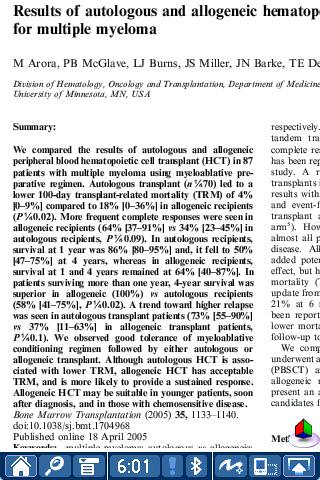
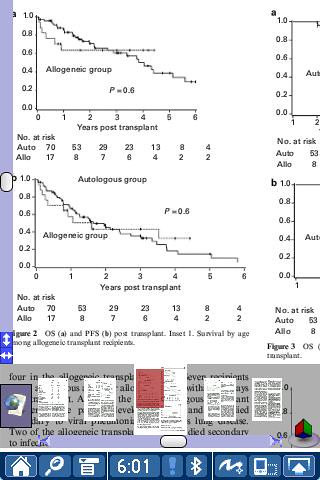
Why native PDF viewing?
It's so convenient and much faster!
Say you get emailed an article, and you can now save the PDF attachment to your SD card and launch Picsel Browser to view it.
When you go to the online version of your favorite journal, you can now download the PDF to your SD card (a card reader is very handy here) and then open it up in Picsel Browser for reading later.
Efficiency is the name of the game. If palmOne is serious about marketing to business and medical users, they should consider bundling Picsel Browser with their PDAs. Until this happens power users now have a temporary working solution ;)
After a bit of experimentation with tips from 1Src, I got Picsel Browser to work full screen on my T3 i.e. display as 320x480. This is so much better as it will show more information at a glance.
The key tools you'll need are Codediver and either Zlauncher or Powerrun
| Instructions Method 1: You have to be running Zlauncher. 1. Click on the PicselBrowser icon for some time 2. Select Move to Card 3. Click on the icon again 4. Select Shortcut 5. You can now find PicselBrowser* (the shorcut in CodeDiver. 6. Set VirtualSilk to Force + Long + Long 7. Click on the PicselBrowser icon again for some time 8. Move to RAM To delete the shortcut, DO NOT use Zlauncher.. Delete it via the FileManager to delete only the shortcut. Otherwise, you may have to reinstall the databases again. Method 2 (the one I used) I don't use Zlauncher but I used Powerrun to move Picsel Browser to card (and thereby get the shortcut). After setting CodeDiver to work on the shortcut, I then used POwerrun to move Picsel Browser back to Ram. |
Screenshots:
Why native PDF viewing?
It's so convenient and much faster!
Say you get emailed an article, and you can now save the PDF attachment to your SD card and launch Picsel Browser to view it.
When you go to the online version of your favorite journal, you can now download the PDF to your SD card (a card reader is very handy here) and then open it up in Picsel Browser for reading later.
Efficiency is the name of the game. If palmOne is serious about marketing to business and medical users, they should consider bundling Picsel Browser with their PDAs. Until this happens power users now have a temporary working solution ;)
Healthy living
PAcific Primary Care has released Healthy Dieting and Exercise as freeware
| Description: This text gives many great examples on how to get started on healthy eating, regular physical fitness and details stress management for persons of all ages. This text is directed toward health care providers to assist them in the education of their patients. Feel free to distribute it to all your patients as even non-medical personnel may also find a lot of useful information, however there may be many technical terms or abbreviations that make it difficult to read. This text will review basic nutrition as well as common fad diets and give an introduction to stress management and exercise techniques that can be used to enhance longevity. |
Sunday, June 19, 2005
Be yet WISER
Well that's my alma mater's motto.
WISER is also the acronym for "Wireless Information System for Emergency Responders" and is a Palm OS-based system designed to assist first responders in identifying and dealing with hazardous material incidents. The system provides access to 390 of the over 4,700 hazardous materials from NLM’s Hazardous Substances Data Bank (HSDB), and allows users to find information either on known substances or to use the system to identify an unknown substance.
WISER is currently available for PalmOS and Pocket PC and is available free from the National Library of Medicine
Saturday, June 18, 2005
Sanford Guide 2005 PDA edition
The new Sanford Guide 2005 PDA edition is now available for download.
The PDA version, for both Palm and Pocket PC platforms, contains the complete contents of the 35th edition of The Sanford Guide to Antimicrobial Therapy.
The new features for Sanford Guide 2005, PDA edition include:
* Searchable version of the complete index only one tap away at all times
* Easy hyperlinks to move through the reference content quickly
* Dynamic hierarchy for rapid navigation of the contents
* Quick look-up of abbreviations
* Special table presentations to pinpoint the answers you need
* A new Jump-To feature to allow even faster navigation
* Bookmarks to enable frequently-accessed material to be found quickly
* Create Notes to customize information on your own PDA
I find the last one interesting as custom Notes are always handy in any Medical PDA reference - all authors should incorporate this feature!
Another big advantage not highlighted, that the PDA version has over the book version are the fonts - I find the book version's fonts so tiny they are barely legible! OK even with my multifocal glasses it's a struggle so I very much appreciate the PDA version and rate it above the book version anytime!
Thursday, June 16, 2005
Journal RSS feeds in your PDA
Since last year I have been using Plucker as my preferred RSS viewer on my Palm. The RSS feeds are "fetched" using Sunrise which is (currently) a free app. Plucker is Opensource so is absolutely free as well.
What we have is a dearth of Medical Journals available as RSS feeds. I do subscribe to some of them as emailed table of contents (e.g. Blood and NEJM). How I wish they were more readily available as RSS feeds.
Well my wish has come true as our friend Leo, over at MedPDA.net has come up with a clever way to use Pubmed to generate RSS feeds from medical journals.
Leo has a list of Journal titles which I find very handy since he and I are in the same field ;). Leo has also kindly shared his technique in this page.
Pocket PC users are also not left out as there is a free Plucker compatible reader for Windows Mobile called Vade Mecum
Here are some screen shots (hosted by Flickr) showing Vademecum and some Medical Journal RSS feeds:
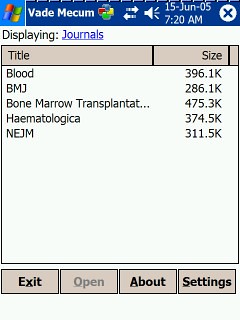
The sizes are a little large since I set the link depth to 1 but probably 0 will do.
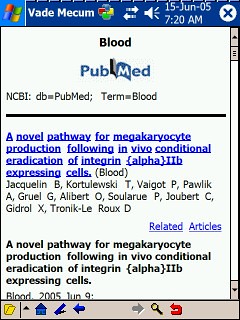
Blood Journal as an RSS feed!
What we have is a dearth of Medical Journals available as RSS feeds. I do subscribe to some of them as emailed table of contents (e.g. Blood and NEJM). How I wish they were more readily available as RSS feeds.
Well my wish has come true as our friend Leo, over at MedPDA.net has come up with a clever way to use Pubmed to generate RSS feeds from medical journals.
Leo has a list of Journal titles which I find very handy since he and I are in the same field ;). Leo has also kindly shared his technique in this page.
Pocket PC users are also not left out as there is a free Plucker compatible reader for Windows Mobile called Vade Mecum
Here are some screen shots (hosted by Flickr) showing Vademecum and some Medical Journal RSS feeds:
The sizes are a little large since I set the link depth to 1 but probably 0 will do.
Blood Journal as an RSS feed!
Monday, June 13, 2005
Trauma and Toxicology
Pacific Primary Care have released Trauma and Toxicology 2006
| Application Description Topics include: Updated ACLS, ATLS, BLS, PALS protocols for quick acces. Complete detailed tx, w/u or Anaphylaxis, Trauma (head-to-toe), Oncology Emergencies, Psychiatric (Suicide, Violence, Acute Psychosis), Toxicology evaluation, Common Toxidromes, Toxic Food Ingestions, Inhalational Injuries, Marine Injuries, Animal & Insect Bites/ Stings, Burns, Radiation, Sexual Assault, Substance Abuse, Foreign Bodies, Pediatrics (PALS, Fever, ...), Cold Injuries, Drowning, Heat Injuries, Flying & Diving, Hyperbaric Medicine, Altitude Sickness, Intubation, Asthma and much more. Other features: Multiple illustrations, referenced, detailed treatments and workups. Edited by a board certified Emergency Physicians with >70 yrs of clinical experience. |
Sunday, June 12, 2005
Viewing native PDF documents
Many medical journals publish their articles in PDF format.
For Palm users, we have the choice of using Adobe's Acrobat viewer for PalmOS or Repligo. The latter is shareware but better than Acrobat.
Both suffer the setback of having to run a converter on your Desktop in order to view it on your PDA.
Well I have good news for you. There is now a way to view Native PDF files on your Palm PDA.
Full details and lots of screenshots can be seen here
In the meantime here are some sample screenshots:
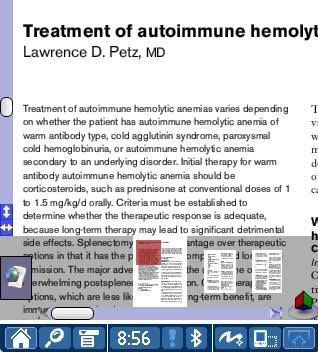
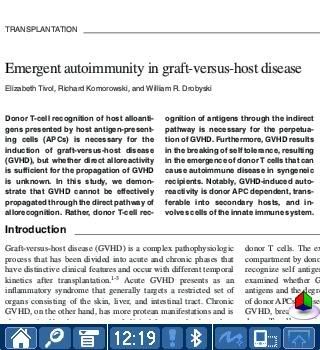
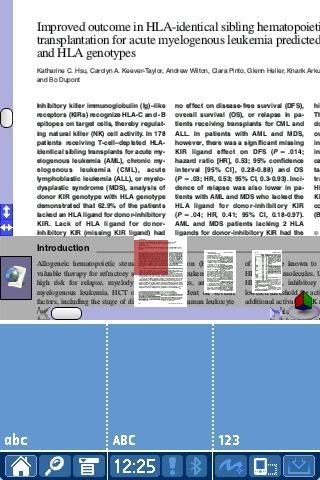
For Palm users, we have the choice of using Adobe's Acrobat viewer for PalmOS or Repligo. The latter is shareware but better than Acrobat.
Both suffer the setback of having to run a converter on your Desktop in order to view it on your PDA.
Well I have good news for you. There is now a way to view Native PDF files on your Palm PDA.
Full details and lots of screenshots can be seen here
In the meantime here are some sample screenshots:
Another Epocrates MobileCME review
pdaMD.com has another excellent Epocrates MobileCME review by Peter Berman.
They also have updated PDA Medical News if you're starved of that......
They also have updated PDA Medical News if you're starved of that......
Thursday, June 09, 2005
What's your new upgrade and UTD
Kent "Ectopic Brain" Willyard has got a Treo 650. Congrats Ken! It's a nice smartphone but for me it has one very serious shortcoming: too little user available Ram. Sure you can Powerrun some apps but once you have Epocrates, Avantgo, IBM Java VM, CJKOS and a few other Ram hungry apps installed, there isn't much room for more. 23MB ain't enough for me. The other concern I have is some reports of sudden soft resets happening. This would be most annoying to me and would defeat the main function of a phone which to me must be absolutely reliable as I use it for communicating with the hospital. This is why I have still shunned convergence devices until I am sure they are rock stable and dependable.
OTOH, you might consider the new LifeDrive. 4GB under the hood is amazing. There are concerns about speed (or rather lack of it) though some new apps like Sharkcache may help speed things up a bit. Already medical publishers like Skyscape are bundling the LD with their apps (see palmOne LifeDrive™? Mobile Manager plus $130 in Clinical Decision Support Tools FREE!).
Well, I am using my trusty T3 for my daily work. My Lifedrive equivalent is a Dell Aximx50v with a 2GB CF card and 512MB SD card. I've finally been able to run Uptodate PocketPC version - something still missing from PalmOS and I hope the UTD publishers will seriously consider supporting PalmOS now that Palm in the LD has the storage capability (LD & UTD users please write to them - I have!)
I find myself using UTD more frequently during rounding nowadays since I have it now (FYI I often do carry two PDAs with me, which is why Dockers MobilePant™? for me is absolutely de rigueur)
Here's a screenshot of UTD in action:
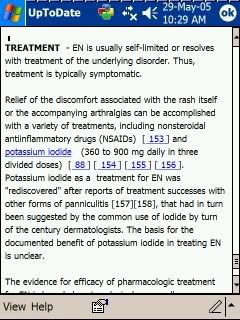
I'll bet you didn't know Potassium iodide could be used to treat Erythema nodosum ;)
OTOH, you might consider the new LifeDrive. 4GB under the hood is amazing. There are concerns about speed (or rather lack of it) though some new apps like Sharkcache may help speed things up a bit. Already medical publishers like Skyscape are bundling the LD with their apps (see palmOne LifeDrive™? Mobile Manager plus $130 in Clinical Decision Support Tools FREE!).
Well, I am using my trusty T3 for my daily work. My Lifedrive equivalent is a Dell Aximx50v with a 2GB CF card and 512MB SD card. I've finally been able to run Uptodate PocketPC version - something still missing from PalmOS and I hope the UTD publishers will seriously consider supporting PalmOS now that Palm in the LD has the storage capability (LD & UTD users please write to them - I have!)
I find myself using UTD more frequently during rounding nowadays since I have it now (FYI I often do carry two PDAs with me, which is why Dockers MobilePant™? for me is absolutely de rigueur)
Here's a screenshot of UTD in action:
I'll bet you didn't know Potassium iodide could be used to treat Erythema nodosum ;)
Saturday, June 04, 2005
Eiweight
One of the formulaes missing from Medcalc is the ability to calculate body fat.
There's a freeware app which can do this and track your weight as well : Eiweight
This reminds me of Fatcalc which I wrote and which also has the ability to track your weight and measurements including body fat (albeit non-graphical). I have withdrawn Fatcalc from Palmgear due to issues I have with them. Thanks to all who donated (it was donation ware to a Leukaemia charity) but I am sorry to say that I have not been able to get a single $ from Palmgear as they have insisted on mailing me cheques in US$ in tiny amounts despite my written instructions to the contrary. What happens is if I were to bank in the US$ cheque in my local bank, the bank commission would be many times the amount! As it was donationware, and to honor those who have donated, I shall be making a personal donation to the Leukaemia fund. I am thinking of re-releasing it as freeware at a later date once I have the time to re-write the code.
There's a freeware app which can do this and track your weight as well : Eiweight
 Description: This software is for recording weight and bodyfat. This software can indicate weight and the rate of body fat by graph. |
This reminds me of Fatcalc which I wrote and which also has the ability to track your weight and measurements including body fat (albeit non-graphical). I have withdrawn Fatcalc from Palmgear due to issues I have with them. Thanks to all who donated (it was donation ware to a Leukaemia charity) but I am sorry to say that I have not been able to get a single $ from Palmgear as they have insisted on mailing me cheques in US$ in tiny amounts despite my written instructions to the contrary. What happens is if I were to bank in the US$ cheque in my local bank, the bank commission would be many times the amount! As it was donationware, and to honor those who have donated, I shall be making a personal donation to the Leukaemia fund. I am thinking of re-releasing it as freeware at a later date once I have the time to re-write the code.
Thursday, June 02, 2005
Unbound's Medicine Central
Press Release:
| Charlottesville, VA, June 1, 2005 — Today, Unbound Medicine, a leader in information for healthcare providers, announced the release of Medicine Central™. Designed especially for internists, primary care providers and trainees, Unbound’s new resource combines premier reference content with powerful literature management tools—all easily accessible using a personal digital assistant (PDA), a wireless device, or the Web. With Medicine Central, clinicians configure their own comprehensive suite of disease, drug, and diagnostic test information by first selecting a core medical text—5-Minute Clinical Consult, Harrison’s Manual of Medicine, or CURRENT CONSULT Medicine. Other highly regarded titles from McGraw-Hill, Lippincott Williams & Wilkins, and F.A. Davis complete the package. Medicine Central enhances these premier titles through Unbound’s award-winning platform, which includes personalized journal tracking and literature searching. "Regardless of physical location, nomadic clinicians can get quick answers to clinical questions or keep up with the literature," said William Detmer, MD, president and CEO of Unbound Medicine. "Users have the freedom to select their favorite medical reference and get the information they need on both the Web and their handheld device of choice." Medicine Central joins Unbound’s Anesthesia Central™ as part of a new product series that provides all-in-one mobile solutions for individual practitioners in targeted specialties. Like the related institutional product, Unbound Central™, it combines the powerful and user-friendly features of the Unbound platform with respected clinical content. For more information about Medicine Central please visit the Unbound Medicine store |
Sunday, May 29, 2005
Skyscape 320x480 support
The latest Skyscape versions of their popular medical applications for PalmOS now (finally!) support 320x480 resolution which affords a view of more text at a glance. This is a boon for devices like the T3 and the T5

Screenshot of PalmOS version

Screenshot of PPC version
Previously with only 320x320 support, the PalmOS versions displayed less text per screenful compared to the PPC versions. Now they are about the same.
I notice though that the search on the T5 is still slow as previously reported
Screenshot of PalmOS version
Screenshot of PPC version
Previously with only 320x320 support, the PalmOS versions displayed less text per screenful compared to the PPC versions. Now they are about the same.
I notice though that the search on the T5 is still slow as previously reported
Saturday, May 28, 2005
Loading up the LifeDrive
Now that a Palm PDA has oodles of storage space, I wasn't suprised to read that vendors are now taking advantage and loading clinical apps on it.
From MobileHealthData:
PDA Verticals
Two more medical applications which currently are available only on WM that I would like to see ported to PalmOS are UpToDate (currently you can only access it wirelessly from the Palm) and DiagnosisPro.
From MobileHealthData:
| Redmond, Wash.-based PDA Verticals Corp. will embed 1,000 LifeDrive PDAs from Milpitas, Calif.-based palmOne with clinical reference applications tailored to various specialties. The vendor will display and sell the PDAs at health care industry trade shows. PDA Verticals will load each of its LifeDrive PDAs with up to seven clinical reference applications. The vendor also offers remote management and updates to the software, as well as the addition of other hand-held applications at a physician's request. |
PDA Verticals
Two more medical applications which currently are available only on WM that I would like to see ported to PalmOS are UpToDate (currently you can only access it wirelessly from the Palm) and DiagnosisPro.
The ultimate PDA for free?
I was intrigued to see a post in The Book of Joe about The ultimate PDA — and it's essentially free.
Anyway before you get overly excited, it's really nothing - just index cards and a binder clip, dubbed the "Hipster" PDA!
Here's something even cheaper and more "handy":

I really can't recommend either to doctors ;)
The big argument against traditional PDAs has been that if you forget to charge your PDA, then you lose all your data (especially if you forget to or don't bother to backup your data either on SD or Hotsync, something many of my colleagues are guilty of!).
Well fear not for the latest generation of PDAs from PalmOne now use non-volatile Ram which retains your precious data even if the charge runs out. The only way the data is lost is by a hard reset. I think this is a big plus and I'll put up with any bugs the NVFS might have but at least it shows PalmOne is still pioneering the way and Microsoft has some catching up to do here - though WM2005 will support this feature.
Anyway before you get overly excited, it's really nothing - just index cards and a binder clip, dubbed the "Hipster" PDA!
Here's something even cheaper and more "handy":
I really can't recommend either to doctors ;)
The big argument against traditional PDAs has been that if you forget to charge your PDA, then you lose all your data (especially if you forget to or don't bother to backup your data either on SD or Hotsync, something many of my colleagues are guilty of!).
Well fear not for the latest generation of PDAs from PalmOne now use non-volatile Ram which retains your precious data even if the charge runs out. The only way the data is lost is by a hard reset. I think this is a big plus and I'll put up with any bugs the NVFS might have but at least it shows PalmOne is still pioneering the way and Microsoft has some catching up to do here - though WM2005 will support this feature.
Friday, May 27, 2005
Clinical Orthopedics
Pacific Primary Care has updated Clinical Orthopedics in Palmgear.
| Application Description The topics included: everything orthopedic you can imagine, from head to toe. It includes emergency procedures, diagnostic procedures, detailed therapeutic and rehab info as well as many illustrations. This text is very extensive, it covers a vast amount of information. Great for any primary care physician, resident or even a medical student. |
Thursday, May 26, 2005
OnTimeRx
OnTimeRx 2.5, is an award-winning Medication Reminder and Healthcare Schedule Manager. Now updated for the PPC platform. It's of course also available on the Palm and I would recommend it highly for all and encourage doctors to beam the app to their patients if they have PDAs. I have!
Wednesday, May 25, 2005
Pepid
Pepid - Portable Healthcare Expertise in the Palm of your hand, has been updated to version 6.1 as of April 2005.
Various "suites" to suit your specialty are available - both on PDA as well as Online.
Various "suites" to suit your specialty are available - both on PDA as well as Online.
| What's New in PEPID Version 6.1 April 2005 Introducing! evidence-based medicine PEPID's value as a research tool is enhanced by monographs developed by PEPID and the Family Physicians Inquiry Network (FPIN). Nearly 200 Clinical Inquiries from practicing physicians are now linked to medical and pharmaceutical content within PEPID PCP and CRC software. Introducing! PEPID OnCard Installs and updates just got easier! Now it's simply plug 'n play with a PEPID OnCard. Avoid the hassles of slow connections and firewalls. Get your favorite PEPID content delivered to you door on a memory card. Click here learn how easy it is to keep vital reference information current. Improved New navigation enhancements Now get even quicker access to critical information with our improved navigation and toolbar. With over 10,000 entries, the PEPID index has always been the fastest way to information. Now we've made it even faster by colorizing drug topics in blue; bolding and capitalizing keywords. 6.1 Highlights * Major update with content additions and system improvements. * All suites include: 1. Major content updates and revisions (see individual products for details). 2. 37 new drugs, 36 new interaction generators.* 3. Beer's criteria for medication use in elderly. 4. Improved PocketPC performance enhancements for quicker data access. 5. Palm performance enhancements for better usability. 6. See individual products for more specific software update information. |
Sunday, May 22, 2005
NFP
NFP v2.6 has been released on Freewarepalm
Freeware but do be warned that Natural Family Planning methods are not foolproof and have the highest rates of failure if you are relying on it to avoid pregnancy.
Description: A freeware program for tracking fertility, known as the Sympto-thermal Method, Fertility Awareness Method, Natural Family Planning, or Ovulation Method. NFP is a program designed for Palm OS that allows a woman or a couple to track her fertility using a set of simple daily measurements. NFP can be used either to avoid or achieve pregnancy. It can be an effective chemical-free method of contraception, or it can be an inexpensive method of conception. |
Freeware but do be warned that Natural Family Planning methods are not foolproof and have the highest rates of failure if you are relying on it to avoid pregnancy.
Thursday, May 19, 2005
ProfileMD Classic
"Easy way to keep up with 10 surgeries, 5 doctors & 23 prescriptions a month. I'd be lost without it"
I guess if you are in the same boat as this satisfied user, you would appreciate software like ProfileMD Classic - now updated to version 1.04
Description:
ProfileMD Classic is a FREEWARE personal health record that can give you instant access to your medical history in case of emergencies, physician office visits, or anytime you need the details of your medical history around-the-clock, anywhere in the world from your PalmOS PDA.
ProfileMD can help reduce medical errors by providing rapid access to accurate medical information.
ProfileMD can help cut down on redundant tests, procedures, treatments, and vaccinations by recording this crucial information.
Well I sometimes wish my patients would be more accurate and forthcoming with details of their medical history and if more patients had PDAs running software like this I am sure your doctors would be well pleased.
Wednesday, May 18, 2005
FitnessPlus
FitnessPlus sounds like a fantastic free program for all you fitness fanatics (not couch potatoes like me!)
| Description: FitnessPlus is a comprehensive and powerful fitness tracking software for Palm OS, Windows, and Windows Mobile devices. Your can use FitnessPlus for diet and exercise tracking to achieve weight loss or weight gain goals, or simply to track your overall fitness and daily nutrition intake. |
Lifedrive goes Live!
It's official. The LifeDrive is real since it now appears in palmOne's website. It belongs to a new category of devices palmOne terms "Mobile Managers".
You can view a cool Product Tour
A couple of things missing from the Specs page - does it have 32MB ram or 64MB ram? Does it support USB2.0? The latter I think is important since the 4 GB drive is built in and if you want to transfer a large video clip (not necessarily for entertainment - maybe an angiogram clip or something!) transferring over USB 1.1 would be painfully slow compared with 2.0
I have a 2 Gb CF card for my Dell Axim x50v and it's a cinch removing it and plugging it into my USB 2.0 card reader for those extra large files.
PIC mentions it has 64MB Ram and supports USB 2.0 so this sounds good.
I personally think this device will be great for doctors and healthcare providers - especially if you have wireless connectivity where you work....
Tuesday, May 17, 2005
Concise Guide to Drug Interaction
Skyscape has released Concise Guide to Drug Interaction Principles for Medical Practice Cytochrome P450s, UGTs, P-Glycoproteins, 2nd Ed. on Palmgear.
To be honest, checking on doses and using Epocrates' Multicheck drug interaction checker is more than enough for me! But if you want to go into the nitty gritty, then perhaps you could check this out....
| An understanding of drug interactions has become essential to the practice of medicine. Since publication of the first edition of this Concise Guide in 2001, our increasing pharmacopoeia - coupled with prolonged human life spans - has made polypharmacy commonplace. Like the first edition of this unique pocket reference, the Second Edition is written expressly for clinicians. With four new contributors, this bestseller includes expanded sections on both phase I and phase II metabolism, updates of existing chapters and tables, new graphics, and extensive Web site references. Brand-new chapters discuss P-glycoproteins, "minor" cytochrome P450 enzymes, pain management with narcotic and nonnarcotic analgesics, prescribing guidelines, and medicolegal issues. |
To be honest, checking on doses and using Epocrates' Multicheck drug interaction checker is more than enough for me! But if you want to go into the nitty gritty, then perhaps you could check this out....
Monday, May 16, 2005
New USBMIS Titles
USBMIS has announced a couple of new PDA titles:
Schwartz Principles of Surgery, PDA Edition
Just the Facts in Emergency Medicine, PDA Edition
Schwartz Principles of Surgery, PDA Edition
Just the Facts in Emergency Medicine, PDA Edition
Friday, May 13, 2005
New free Palm medical programs
Spotted in Ectopic Brain....
Dr. Beren of CZR Technologies has released 4 free medical applications:
Abnormal Pap Smear
Drugs in Pregnancy
Depression
Abnormal INR
Dr. Beren of CZR Technologies has released 4 free medical applications:
Abnormal Pap Smear
Drugs in Pregnancy
Depression
Abnormal INR
Frank Shann's Drugdoses for PDA
Sanjay, my paediatrician colleague who just got a Tungsten E2, is now getting into the thick of PDAs. He asked me about Frank Shann's DrugDoses - a Pediatric drug reference which originates from Australia. I initially looked for it without success but Dobbs managed to locate it! Thanks Dobbs..
The website is DrugDoses for PDA and you can download and evaluate a PDA version (Palm and Pocket PC) of Frank Shann's booklet

If you want a review, you can head over to Swiss-Pediatrics.org, but if you are not fluent in French, then with the help of Google, you can read an English version here
The website is DrugDoses for PDA and you can download and evaluate a PDA version (Palm and Pocket PC) of Frank Shann's booklet
| Description: It has never been so easy to have a copy of Drug Doses with you at all times! The PDA version (for Palm and PocketPC) of the booklet takes less than 350k, and it gives you an enormous amount of information. The PDA version contains all the drugs that are in the booklet, but you can find them much faster. In addition, you will also be able to download updated versions of the database every few months. The PDA version also gives you access to a lot of other information. We have included many current laboratory values, a useful cardiology database and a calculator that will help you give the correct doses when you are resuscitating a child. The PDA versions are developed by Dr O. Karam, Geneva, Switzerland. |
If you want a review, you can head over to Swiss-Pediatrics.org, but if you are not fluent in French, then with the help of Google, you can read an English version here
Thursday, May 12, 2005
Guidelines for the Treatment of Psychiatric Disorders
Skyscape has a new title out, Quick Reference to the American Psychiatric Association Practice Guidelines for the Treatment of Psychiatric Disorders, Compendium 2004:
 Description: Contains Quick Reference Guides (QRGs) to all of the published APA Practice Guidelines. QRGs are created by abstracting the crucial information from the text of the full guideline, with greatest emphasis placed on retaining the material most directly relevant to the treatment decision making, and are intended for day-to-day work with patients. |
Saturday, May 07, 2005
Clinical Neurology 2006
Pacific Primary Care have released Clinical Neurology 2006
| Application Description: Topics include: evaluation of weakness, neuropathy, myasthenia gravis, demyelinating disease including MS and Guillain-Barre, carpal tunnel, cerebellar disorders, movement disorders (tics, Tourette, dystonia..), tremors, Parkinsons, cerebral palsy, ALS, seizures, strokes, headaches, coma, cervical spine problems, low back pain, radiculopathy, sciatica, myofacial pain, sacroiliac dysfunction, ankylosing spondylitis and pseudo-neurological syndromes. To help you manage and treat anything that walks through the door. It is constantly updated, adding the latest and greatest medical management, drugs, dosages, and evidence based medical pearls. |
Lifedrive: a great PDA for doctors?
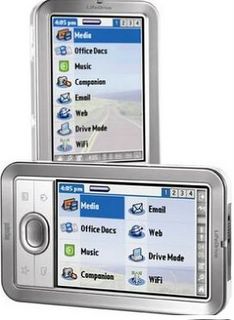
The Palm PDA community is alive with anticipation of palmOne's new "Lifedrive" expected to be announced sometime the second half of May.
I think this will be the one medical PDA users will think of upgrading to (that is if you have been holding back), simply because it has 2 key features: dual wireless (the Wifi being the missing link in previous palmOne models other than the T|C) and a huge 4 GB storage which will be great for multimedia files. Now radiologists can consider putting images on the PDA. Large medical references should be no problem - perhaps UpToDate can finally come up with a PalmOS version and not only PPC. It's still a rumor but the drum beats are getting louder :)

Thursday, May 05, 2005
New Skyscape releases
Nurse Oncologists are precious. If you are an Oncologist and have a good team of nurses, then make sure you keep them.
Perhaps reward them with the latest update from Skyscape :
2005 Oncology Nursing Drug Handbook
I haven't used this but I guess if you are a trainee at the MGH, you might be interested in the PDA version of The Massachusetts General Hospital Handbook of Internal Medicine, 2nd Ed.
Perhaps reward them with the latest update from Skyscape :
2005 Oncology Nursing Drug Handbook
I haven't used this but I guess if you are a trainee at the MGH, you might be interested in the PDA version of The Massachusetts General Hospital Handbook of Internal Medicine, 2nd Ed.
Palm Pediatrics
A colleague of mine just got his first PDA - a palmOne Tungsten T|E2 which is one of palmOne's newest PDAs and one which I think is value for money given the specifications. Well, it's never too late!
Right now he's discovering what he has been missing but he has asked for more links and suggestions to put in his Palm.
I can suggest two good sites for Pediatricians:
Pediatrics on Hand
PedsPalm.com
Welcome to the world of PDAs, Sanjay!
If anyone has any other Pediatric PDA links, please let me know.
Tuesday, May 03, 2005
Depression PHQ-9 Beta
Statcoder has released Depression PHQ-9 Beta on Palmgear.
This is another great freebie from the creator of numerous other PalmOS medical applications. Statcoder a.k.a. Andre Chen has not released any version for the PPC, but has also taken note of StyleTap as he has put up this page of info on running Statcoder apps on the PPC
 Application Description: The Patient Health Questionnaire (PHQ-9) The Patient Health Questionnaire contains a brief, 9-item, patient self-report depression assessment specifically developed for use in primary care (PHQ-9). The PHQ-9 has demonstrated usefulness as an assessment tool for the diagnosis of depression in primary care with acceptable reliability, validity, sensitivity, and specificity. The nine items of the PHQ-9 come directly from the nine DSM-IV signs and symptoms of major depression. |
This is another great freebie from the creator of numerous other PalmOS medical applications. Statcoder a.k.a. Andre Chen has not released any version for the PPC, but has also taken note of StyleTap as he has put up this page of info on running Statcoder apps on the PPC

Monday, May 02, 2005
Haemoncrules on a PPC (II)

Wooikok confirms that Haemoncrules works on the PPC using StyleTap. Here's a screenshot (provided by Wooikok - many thanks)
Sunday, May 01, 2005
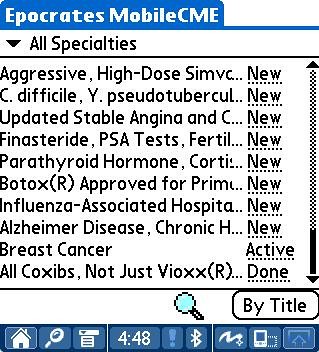
Epocrates Mobile CME Review
I have provided a walk-through and a small review of the new Epocrates MobileCME service which is a free add-on tool for all Epocrates users
I would highly recommend you install this if you are an Epocrates user. It's user friendly and of great educational value even for those of us outside the USA where the CME points submitted to AMA would be meaningless (hint, hint Epocrates, please go truly International!!)
Sample screenshot from the review:
I would highly recommend you install this if you are an Epocrates user. It's user friendly and of great educational value even for those of us outside the USA where the CME points submitted to AMA would be meaningless (hint, hint Epocrates, please go truly International!!)
Sample screenshot from the review:
Ultimate Anesthesia Quick Reference
The Ultimate Anesthesia Quick Reference was recently updated in Memoware. This is a free iSilo pocket anesthesia reference.
Description
Description
| Contains lists, charts, checklists, guidelines, etc. # Respiratory Events and Treatments. # Cardiovascular Events and Treatments. # Metabolic, Electrolyte, and Hematologic Events and Treatments. # Neurologic Events and Treatments. # Subspecialty Anesthesia Reference: cardiac, vascular, pulmonary, obstetrics, pediatrics, regional, pain, coagulation, medications. Quick-tap hypertext links to related pages. Any page can be accessed through the Table of Contents or the Alphabetical Index. |
Saturday, April 30, 2005
Epocrates MobileCME
Epocrates wishes to remind users of their MobileCME service
| Epocrates® is thrilled to announce a new way of earning CME credits – the MobileCME™ learning system. Clinicians can now earn CME credit conveniently from their handheld device any where, any time. MobileCME from Epocrates is unlike any other program because you can * Complete CME programs any where, any time * Read articles, answer questions and request your certificate, all from your mobile device * Learn from esteemed faculty and other leading researchers * Use your down time to stay current, earn and document your CME credits The MobileCME continuing medical education solution is available at no charge for all Epocrates Essentials, Epocrates Rx Pro and Epocrates Rx users and enables you to take CME on your Palm OS® or Pocket PC OS handheld device, wherever you are, whenever you have time! MobileCME is also compatible with Palm OS users syncing to a Mac computer. |
Friday, April 29, 2005
Haemoncrules on a PPC
Want to be able to run Haemoncrules on a PPC? Well I haven't ported it over yet :P but if anyone wants to try, they can install StyleTap which claims to be able to run PalmOS applications on a Windows Mobile device..
Anesthesia Central
Unbound Medicine has launched Anesthesia Central, a collection of PDA, Web and Wireless apps for Anesthetists. Unbound bills this as "A premier collection of disease, drug, test, procedure, and literature information for anesthesiologists, critical care specialists, nurse anesthetists, and trainees. Includes access on PDA, Web & wireless devices via Unbound's award-winning platform!"
Thursday, April 28, 2005
Splinting Manual for PDA
MeisterMed has released Splinting Manual for PDA which is a free iSilo reference which makes full use of the graphics and text linking capabilities of iSilo
| Adapted from the Ortho-Glass® Splinting Course Manual (Fifth edition) by MeisterMed with the permission of the publisher. Includes indications, techniques, and step-by-step instructions with illustrations for applying nineteen types of splints to the upper and lower extremities. A handy refresher for those who don't put on splints every day. Will also be a great teaching tool for medical students and residents. |
Wednesday, April 27, 2005
Phatnotes as your peripheral brain
Back in November I blogged about Memoleaf being another way to organize your Palm Memos. Memos are a great way to keep Pearls, sinppets of info and are a great replacement for those Index cards (I sure hope Jim Zaslavsky is reading this!).
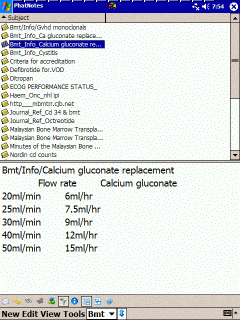
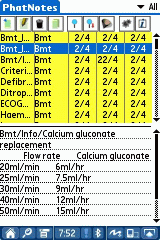
What if you are an owner of a Pocket PC? One of the worse things about Windows mobile is the horrible PIM organisation. Memos are stored as individual text files in My Documents and it is simply terrible if you try to use these "Notes" as your Peripheral Brain. You'll need a third party app and one that seems to be popular is Phatnotes which functions as a Notes replacement for Pocket PCs. If you get the Professional edition, then the nice thing is there is also Phatnotes for PalmOS. So if you are an owner of both a Palm and a PPC, you can keep your Notes/Memos synched easily between both devices. The setup will install a Phatnotes Desktop module (you can import Outlook Memos into the Phatnotes desktop) and this will sync with both the Palm and PPC. Neat!
Screenshots:
Phatnotes on a PPC
Phatnotes on a Tungsten T3
What if you are an owner of a Pocket PC? One of the worse things about Windows mobile is the horrible PIM organisation. Memos are stored as individual text files in My Documents and it is simply terrible if you try to use these "Notes" as your Peripheral Brain. You'll need a third party app and one that seems to be popular is Phatnotes which functions as a Notes replacement for Pocket PCs. If you get the Professional edition, then the nice thing is there is also Phatnotes for PalmOS. So if you are an owner of both a Palm and a PPC, you can keep your Notes/Memos synched easily between both devices. The setup will install a Phatnotes Desktop module (you can import Outlook Memos into the Phatnotes desktop) and this will sync with both the Palm and PPC. Neat!
Screenshots:
Phatnotes on a PPC
Phatnotes on a Tungsten T3
A couple of new cardiology titles
Dx/Rx: Valvular Heart Disease
Dx/Rx: Coronary Thrombosis
are a couple of new titles from Skyscape that those in the cardiology field might want to check out....
Dx/Rx: Coronary Thrombosis
are a couple of new titles from Skyscape that those in the cardiology field might want to check out....
Southbeach Diet on your Palm
Skyscape seems to have gone to the general health consumer market for the first time, and not concentrating on medical/health professionals alone with the release of the Southbeach Diet Onhand
I just wish to remind Asian PDA users (or really anyone who fancies Asian food!) that a PalmOS standalone version of the Asian Food Calorie Counter is available (previously this was available only as a HanDbase or MobileDB database)
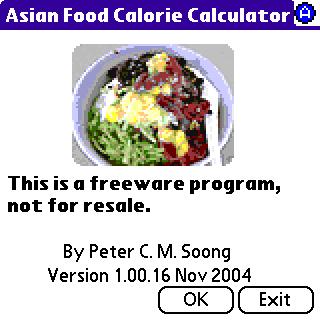
This freeware app created by my buddy Peter Soong, is available for free from the Files section if you join the KVPUG Yahoo group (again membership is free, and you are welcome even if you are not from the Klang Valley!)
 The South Beach Diet™ OnHand is the perfect complement to the best-selling South Beach Diet™ book created by Dr. Arthur Agatston, M.D., preventative cardiologist and inventor of the Agatston Score. The convenience and the portability of the OnHand application allow users an easy way to track their progress and stick to their diet when they are traveling, shopping for groceries, or eating in restaurants. |
I just wish to remind Asian PDA users (or really anyone who fancies Asian food!) that a PalmOS standalone version of the Asian Food Calorie Counter is available (previously this was available only as a HanDbase or MobileDB database)
This freeware app created by my buddy Peter Soong, is available for free from the Files section if you join the KVPUG Yahoo group (again membership is free, and you are welcome even if you are not from the Klang Valley!)
Monday, April 25, 2005
Easy Pulse
Taking the pulse rate may not be so convenient nowadays with digital display watches or worse still analog watches with no second hand (like mine!)
You may want to check out EasyPulse v1.0:
Freeware.
You may want to check out EasyPulse v1.0:
 Description: Need to take a manual pulse? Forgot your wrist watch? No second hand? Not so good at math? Let EasyPulse do the work of calculating the heart rate for you. Simply count 20 beats using the start and stop and let EasyPulse determine the heart rate! |
Freeware.
Not everyone is convinced...
The Philadelphia Inquirer has an article about Doctors and PDAs
I agree that PDAs are not everything and yes, they make alot of difference compared to the 45 pound books.
I just don't understand Jim's logic (or lack of it) though . Maybe it's just ignorance. You can store much more in that PDA than a whole stack of index cards and it'll be much faster looking up the info too, Jim!
| Both student doctors and practicing physicians say the PDAs are no replacement for that medical standby: memory. To use the device, they say, you've got to know where to start, from the disease's cause to the drug name. "It's just a different way to do research rather than using those 40-pound books," said Gloria Donnelly, dean of the Drexel University College of Nursing and Health Professions, which began requiring nursing students to use PDAs three years ago. "They look up the drugs and the lab values before they see a patient or review a condition." Not everyone thinks the electronic gadgets are the wave of the medical future. Jim Zaslavsky, a fourth-year student at the clinic with Koth, walked around with seven index cards in his pockets, along with a pamphlet-size pharmacopeia and several yellow sticky notes. "I just don't have the time to look it up on a gadget," the orthopedic surgery student said. "If a kid breaks his arm, I just need to know what to do." |
I agree that PDAs are not everything and yes, they make alot of difference compared to the 45 pound books.
I just don't understand Jim's logic (or lack of it) though . Maybe it's just ignorance. You can store much more in that PDA than a whole stack of index cards and it'll be much faster looking up the info too, Jim!
Saturday, April 23, 2005
Treo650 in Healthcare
TreoCentral has an interesting thread on this issue.
If you are a doctor with a Treo650, or considering getting one, it's worth a read - lots of real-life experiences here!
If you are a doctor with a Treo650, or considering getting one, it's worth a read - lots of real-life experiences here!
Friday, April 22, 2005
Sanford Guide 2005 beta testers needed
USBMIS is calling for beta testers for their Sanford Guide 2005 - Palm and PPC versions.
Thanks to medPDA.net for the heads up.
I've registered...
Thanks to medPDA.net for the heads up.
I've registered...
Thursday, April 21, 2005
MIMS Asia (beta) review
For a long time, medical PDA users in Asia had to contend with drug databases with a North American flavor. But now, doctors and pharmacists across Asia can access MIMS Pda and Mims Interact on their PDAs (Pocket PCs only for the time being)
The installation is rather rudimentary as you have to copy the Cab file over to your Pocket PC and then run the setup from there. This forces one to install to precious Ram and it would be better to have a proper setup and give users a choice to install onto built-in or SD/CF media. I'll be just reviewing the Product database.
(images stored in Flickr)
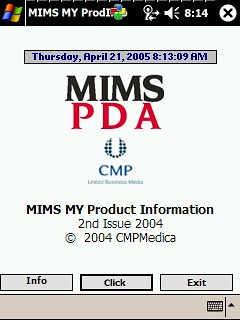
The splash screen prompts one to download the latest version before clicking to proceed. There is no apparent expiry date and it seems to be based on a 2004 database. As everything is stored in Ram, it eats up 2MB+ of resources.
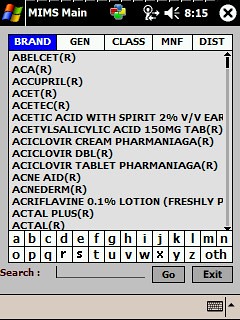
The layout is quite nice, and the interface is tabbed - you can select to view by Brand, Generic name, Class, Manufacturer or Distributor
I find that useful as sometimes we can't quite recall the names and need to jog our memory on products from particular manufacturers or class of drugs.
The listing in this beta version is far from complete nor up-to-date as some "newer" drugs are not found.
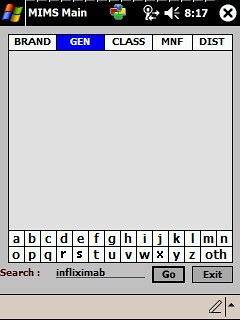
I tried searching for less commonly used drugs like some monoclonals. This screen capture shows a search for Infliximab turning up a blank! Rituximab is also not listed. However, basiliximab can be found.
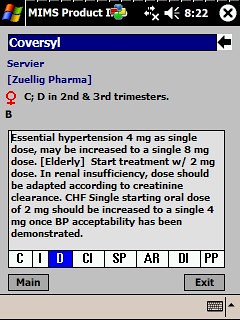
Individual drugs have more information laid out in a neat tabbed format for Indications, Dosages, Adverse reactions etc. There isn't any information on regional pricing.
You'll note the text is a little blurry. I'm afraid the application doesn't seems to support Cleartype fonts. But nevertheless it is clear enough to read though Cleartype support would be very welcome.
Conclusions:
A promising start for MIMS Asia but much remains to be done.
Pros:
At last a drug database for Asian doctors - very timely indeed since trade names here are often different
Neat design and layout, nice tabbed interface
Cons:
Sluggish performance.
Cleartype fonts not supported.
Out of date database - but then this is a demo. It remains to be seen how updates are done - hopefully automatically over Activesync and not manual reinstalls.
Rudimentary installation. Requires Cab installation. No option to install on Storage cards to save on Ram (important for Pocket PCs)
The most serious omission of all is the lack of a PalmOS version. PalmOS toting doctors still vastly outnumber Pocket PC users. If I am not mistaken, the developers of this product used Appforge since an Appforge booster module is included in the installation. It should not be difficult then to port a PalmOS version!
MIMS PDA Australia/NZ in contrast is a mature product and they have both Palm and Pocket PC versions. MIMS Asia should take a cue from their Australian counterparts and follow their excellent example on dual platform support.
The installation is rather rudimentary as you have to copy the Cab file over to your Pocket PC and then run the setup from there. This forces one to install to precious Ram and it would be better to have a proper setup and give users a choice to install onto built-in or SD/CF media. I'll be just reviewing the Product database.
(images stored in Flickr)
The splash screen prompts one to download the latest version before clicking to proceed. There is no apparent expiry date and it seems to be based on a 2004 database. As everything is stored in Ram, it eats up 2MB+ of resources.
The layout is quite nice, and the interface is tabbed - you can select to view by Brand, Generic name, Class, Manufacturer or Distributor
I find that useful as sometimes we can't quite recall the names and need to jog our memory on products from particular manufacturers or class of drugs.
The listing in this beta version is far from complete nor up-to-date as some "newer" drugs are not found.
I tried searching for less commonly used drugs like some monoclonals. This screen capture shows a search for Infliximab turning up a blank! Rituximab is also not listed. However, basiliximab can be found.
Individual drugs have more information laid out in a neat tabbed format for Indications, Dosages, Adverse reactions etc. There isn't any information on regional pricing.
You'll note the text is a little blurry. I'm afraid the application doesn't seems to support Cleartype fonts. But nevertheless it is clear enough to read though Cleartype support would be very welcome.
Conclusions:
A promising start for MIMS Asia but much remains to be done.
Pros:
At last a drug database for Asian doctors - very timely indeed since trade names here are often different
Neat design and layout, nice tabbed interface
Cons:
Sluggish performance.
Cleartype fonts not supported.
Out of date database - but then this is a demo. It remains to be seen how updates are done - hopefully automatically over Activesync and not manual reinstalls.
Rudimentary installation. Requires Cab installation. No option to install on Storage cards to save on Ram (important for Pocket PCs)
The most serious omission of all is the lack of a PalmOS version. PalmOS toting doctors still vastly outnumber Pocket PC users. If I am not mistaken, the developers of this product used Appforge since an Appforge booster module is included in the installation. It should not be difficult then to port a PalmOS version!
MIMS PDA Australia/NZ in contrast is a mature product and they have both Palm and Pocket PC versions. MIMS Asia should take a cue from their Australian counterparts and follow their excellent example on dual platform support.
Wednesday, April 20, 2005
Lexi-Comp Offers Free Calculator App
From mobileHealthData:
For more information, go to lexi.com.
| Hudson, Ohio-based Lexi-Comp Inc. is offering free hand-held medical calculator software to subscribers of its PDA-based suite of clinical reference applications. The Lexi-CALC software includes calculators for body mass index; body surface area; creatinine clearance; heparin dosing; ideal body weight for adults and children; and medication concentrations. |
For more information, go to lexi.com.
Tuesday, April 19, 2005
Radiology Review Manual
Radiology Review Manual 5th Ed. is now available from Skyscape
 The #1 radiology board review - the Green Book - is now available in PDA format! Dr. Dähnert's Radiology Review Manual has helped thousands of readers prepare for - and successfully complete - their written boards. It's organized by body region (just like the exam) and provides extensive lists of image findings and differential diagnoses associated with specific disease entities. An outline format, a shorthand style, and a thorough index make must-know facts easy to find, review, and remember. |
Sunday, April 17, 2005
Skyscape slow on the Tungsten T5
Evelyn writes:
Thanks for writing Evelyn. Yes, I have observed the lag you describe on the T5. It's even slower than Skyscape applications on a PPC and that's saying something! Skyscape applications definitely work faster on a T3 and indeed even a TT.
I think the problem lies in some memory optimisation issues which only Skyscape can solve. So, perhaps the best way is to write to Skyscape and provide feedback. Hopefully someone from Skyscape is reading this too (I notice some of my previous Skyscape posts have appeared there, eg this one and this one)
| Hello. My name is Evelyn, and I am a 5th year medical student who has just gotten a T5, with no other Palm owned prior to this. I've installed some skyscape products, but now I find that I have a problem. When I open a skyscape application, and I use the search function, eg. I use my stylus to write the word "tuberculosis", the program takes a very long time to register. The letter "t" comes out slowly, then all the topics starting with "t" comes out, and then when I type the next letter "u", the program takes a long time to even register my next letter "u", and so on, when I write the word t-u-b-e-r-c... etc. In other words, there seems to be a LAG TIME. It's very obvious, espcially when I compared it to my other friends' Palm T3 or Sony Clie. In their PDAs, the topics corresponding to the letter written comes out almost instantly. For example, topics for "t" comes out the moment they write "t" and there is no lag time when they write the word "t-u-b-e-r-c-u-l..." etc. The programs respond very fast, compared to mine, where it takes a while... as if my Palm is processing something. The skyscape programs also take rather long time to load, from the moment I click on the Program from the Main Menu, as compared to the T3 or Clie. I noticed this problem not long after I installed the programs, since I've only had this T5 for a few months. I installed programs to a 512Mb SD card. There is no difference when I tried to uninstall from the card, and installed it to the program memory. There is still a lag time present. When I compared iSilo programs with my friend's T3, I still noticed a lag time in opening the software. My friend's software still opened and closed marginally faster, but the lag time is not quite as obvious as in the Skyscape programs. For other applications like Memo or Documents to Go, I think the speed is about the same as the T3. Is that normal? I don't know if you understand what I am saying but I hope that you have an idea of my problem. Have you experienced such problems before or heard of anyone who has? Is there a problem with my particular Palm's hardware? Or is this a general Palm T5 problem? How would you advise me to go about solving this problem? My friend's T3 and Sony Clie (with only a 200 MHz processor) is running faster skyscape and even iSilo programs than my T5, which seems a bit ridiculous to me. I don't know what seems to be the problem. I do hope you understand what I have just told you, and that you can advise me on what to do with this problem. Thank you very much. Sincerely, Evelyn |
Thanks for writing Evelyn. Yes, I have observed the lag you describe on the T5. It's even slower than Skyscape applications on a PPC and that's saying something! Skyscape applications definitely work faster on a T3 and indeed even a TT.
I think the problem lies in some memory optimisation issues which only Skyscape can solve. So, perhaps the best way is to write to Skyscape and provide feedback. Hopefully someone from Skyscape is reading this too (I notice some of my previous Skyscape posts have appeared there, eg this one and this one)
Harrison's Manual of Medicine, 16th edition II
This time, Skyscape has also updated their version of Harrison's Manual of Medicine 16th Ed
 What's new in the 16th Edition: * Initial Evaluation and Admission Orders * Diagnostic Imaging Modalities * Preoperative evaluation of the Medical Patient * Care of the Patient in the Intensive Care Unit * Cancer Prevention in At-Risk Populations * Bioterrorism-Associated Infections * Unstable Angina * Pulmonary Hypertension * Chronic Fatigue Syndrome * Screening and Disease Prevention * Hundreds of tables and images make the content jump |
Saturday, April 16, 2005
Handango Champion Award Finalists
The Handango Champion Award 2005 Finalists have been announced.
I notice two medical applications in the Best Industry Application category:
- Davis Drug Guide (Unbound Medicine) and
- BluefishRx Prescription Writer
Good luck!
I notice two medical applications in the Best Industry Application category:
- Davis Drug Guide (Unbound Medicine) and
- BluefishRx Prescription Writer
Good luck!
Friday, April 15, 2005
New Palm PDAs
Well the TE2 has been launched.
Palminfocentre has also this story about invivodata First to Deploy the Tungsten E2 in Clinical Trials
Well, for ease of use and best bang for the buck I guess it is a good choice.
It seems the rumored Lifedrive may now be called the Tungsten X and may be announced mid-May. This particular model may interest medical professionals more because it is dual wireless and has a huge internal storage - 4 GB. The only downside I can think is the thickness. I sure hope it isn't as thick as 2 T5s!
Palminfocentre has also this story about invivodata First to Deploy the Tungsten E2 in Clinical Trials
| "By deploying our scientific expertise on palmOne's newest handheld product, we will continue to deliver unique solutions that streamline the clinical drug development process and put patients back at the center of research where they belong," said Doug Engfer, president and chief executive officer of invivodata. "We look forward to standardizing on the Tungsten E2 as our device of choice and leveraging its flexibility and ease of use in clinical trials throughout the world." |
Well, for ease of use and best bang for the buck I guess it is a good choice.
It seems the rumored Lifedrive may now be called the Tungsten X and may be announced mid-May. This particular model may interest medical professionals more because it is dual wireless and has a huge internal storage - 4 GB. The only downside I can think is the thickness. I sure hope it isn't as thick as 2 T5s!
Harrison's Manual of Medicine, 16th edition
While I was away, Unbound Medicine has released Harrison's Manual of Medicine, 16th edition. I think it's a good deal that for one price (US$59.95) you get not only the PDA version but Web & Wireless access for a year as well.
Back from a break
The past week I've been away to Sydney for a conference, hence the brief blogging break. Took a PDA with me and my Targus keyboard to take notes during the talks. I think this combo sure beats a laptop in terms of portability as well as battery issues since you could just swop spare batteries (for a PPC) or use a Power-to-go for the Palm T3 or some other battery extender.
The weather in Sydney was beautiful but my main grouse is the lack of free wifi, even in places like Gloria Jeans or Starbucks. Yes Optus charges a minimum AUD$13.20 for one hour of Wifi. Ridiculous.
Christopher P. sent in a request for a Gmail invite - well have sent it to you, Christopher. I've got plenty left over so if anyone wants one, do email me. Just say something nice about this blog or better still share your PDA Medical computing experiences. I'd be particularly interested in those of you out there who have switched from one platform to another e.g. PPC to PalmOS or vice versa.
Thursday, April 07, 2005
Mobile CME
Epocrates now introduces a MobileCME program. Now you can earn CME points on your PDA even if you are waiting in the hsopital cafetaria. Earning CME points while you are in the loo is not recommended since if you lose your stylus in the bowl, or worse still your PDA, you can kiss it goodbye...
| The MobileCME medical education solution is a complimentary service for Epocrates software users that enables you to take CME programs on your Palm OS® or Pocket PC OS mobile device, wherever you are, whenever you have time! Now it's easy to stay abreast of important medical developments in your field and satisfy your continuing medical education requirements, no matter how busy you are, in 3 easy steps: 1. Receive CME programs from respected providers when you AutoUpdate (synchronize while connected to the Internet). 2. Choose a program that interests you, take the program, and answer questions (don't worry if you are interrupted - your program status is automatically stored so you can finish the program later). 3. AutoUpdate a second time and a certificate will be sent to you via email. |
Wednesday, April 06, 2005
Just the Facts
USBMIS have opened invitations for beta testing of Just the Facts in Emergency Medicine by the American College of Emergency Physicians and McGraw-Hill Publishing, for Palm and Pocket PC devices.
| Features include: * Effectively condenses Tintinalli's Emergency Medicin, 5, for a concise, yet comprehensive review. * Standardized, bulleted format stresses key points of epidemiology, pathophysiology, clinical features, diagnosis and differential, and ED care and disposition. * At-a-glance use of prioritized and numbered treatments, quick-reference tables, and key figures assure quick absorption of the material. * Includes special sections that review the various written exams and provide text-taking tips and strategies. * Provides state-of-the art information on antiplatelet agents, pain management, stroke management, new treatments for viral disorders, and more. |
Sunday, April 03, 2005
VOIP
Had a nice chat with Leo of MedPDA.net this morning. We chatted over Skype (free Voice Over Internet Protocol- VOIP - software) and the audio quality was superb with me using my notebook on Wifi and home broadband. I have tested Pocket Skype on my Dell Axim x50v and the audio is pretty good too. The Dell can pair with my Step 1150 Bluetooth headset so it becomes in effect like an Internet phone.
If you haven't tried VOIP then you must. Skype is fast catching on and is very easy to use. The other "standard" is SIP which I have also tried but I found that a litte more complicated.
Skype has a "SkypeOut" paid service whereby you can call normal phones for a very cheap rate. I now have absolutely no qualms making phone calls even for work purposes to medical centres overseas (for me that means US, Canada, UK and Australia, Singapore and the rest of Asia) - it's really cheap.
Palm users have been clamoring (me amongst them) for a PalmOS version of Skype but unfortunately Skype doesn't look like supporting this platform anytime soon. This was one of the reasons I got a PPC - to run Pocket Skype and a couple of other software not available for the Palm.
Tuesday, March 29, 2005
Pretest for medical students
Medical students can now prepare better for their Medical and Surgical clerkships with these new apps from Malone Consulting:
PreTest: Medicine PocketTest 1.22
PreTest: Surgery PocketTest 1.02
Sounds like a great idea and the apps are reasonably priced too.
PreTest: Medicine PocketTest 1.22
PreTest: Surgery PocketTest 1.02
Sounds like a great idea and the apps are reasonably priced too.
Sunday, March 27, 2005
Another PDA Survey
MobileHealthData reports that a survey by Forrester Research found that "Though more than half of U.S. physicians regularly use PDAs, most rely on their hand-helds for administrative tasks rather than accessing clinical data"
The key findings:
- 57 % of physicians regularly use PDAs during the workday
- 80 % who use PDAs track their appointments via the devices
- 87 % use them to store contact information
- 65 % of physician PDA users check drug references via hand-helds
- 7 % of physician PDA users said they use hand-helds to order medications
- 6 % use them to access patient records
- 5 % of respondents use PDAs to view lab results.
It seems to me that doctors will use PDAs for the things which are useful to them and more importantly in a way easy for then to use and will not slow them down in their daily work. This may partly explain why the % really declines when the PDA use involves acessing hospital or pharmacy information.
Its not quite there yet!
[Posted with hblogger 2.0 http://www.normsoft.com/hblogger/]
Thursday, March 24, 2005
Skyscape - which platform?
Someone asked me which looks better - Skyscape apps on Palm or PPC?
Well as someone who now owns bot a Palm (T5) and a PPC (Dell Axim x50v) I can say they both look great.
You can view sample screenshots here
I notice though that the search function on the T5 runs a little slow and this is one of the few things which seems to run slower on the T5 compared with the x50v.
Wednesday, March 23, 2005
Wireless Merck
Preess Announcement:
Here's hoping yet again for palmOne's dual wireless PDA. Many things are going wireless and unless palmOne comes out with a new model with builtin Wifi, they are going to be left far behind. I just got myself a Dell Axim x50v see what a PPC is really like. no I haven't been sucked into the "dark side" ;) as my daily PDA is still the T5. However I must say builtin wireless is very handy. The T5 with 400Mhz though is still much faster than the X50v at 624 Mhz and can run rings round it :P
| Charlottesville, VA, March 22, 2005— Unbound Medicine, a leader in knowledge management solutions for healthcare, today introduced a wireless medical resource for physicians and other healthcare professionals. In partnership with Merck & Co., Inc., Unbound Medicine now gives clinicians 24-hour access to select medical information from the MerckMedicus internet site using their wireless Personal Digital Assistant (PDA), Blackberry, or smartphone. “We are pleased to extend our partnership with Merck to deliver trusted medical information to the point of need,” said William Detmer, MD, president and CEO of Unbound Medicine. “As physicians are constantly on the go during the average day, the new wireless MerckMedicus will help them find answers when questions arise and stay abreast of the latest advances in medicine.” Using Unbound Medicine’s powerful mobile platform, current medical resources can be accessed using a wireless internet connection to www.merckmedicus.com, including: The Merck Manual of Diagnosis and Therapy, MEDLINE Journal abstracts, Pocket Guide to Diagnostic Tests, and Reuters Medical News. The Personal Search Assistant allows clinicians to query more than 11 million medical articles in the MEDLINE database from their handheld or wireless device in real-time without access fees or advertising content. The wireless option is compatible with cellular phones with web-browsing capabilities, smartphones, and other wireless devices that use Pocket PC, Blackberry, or Palm OS operating systems. It follows the launch of Mobile MerckMedicus, which was designed for non-wireless PDAs and introduced by Unbound Medicine and Merck in 2004. For more information on wireless MerckMedicus, or to register, visit www.merckmedicus.com. |
Here's hoping yet again for palmOne's dual wireless PDA. Many things are going wireless and unless palmOne comes out with a new model with builtin Wifi, they are going to be left far behind. I just got myself a Dell Axim x50v see what a PPC is really like. no I haven't been sucked into the "dark side" ;) as my daily PDA is still the T5. However I must say builtin wireless is very handy. The T5 with 400Mhz though is still much faster than the X50v at 624 Mhz and can run rings round it :P
Tuesday, March 22, 2005
Gmail invitations up for grabs!
I've still got plenty of free Gmail invitations so if you can email me & share your Palm/PPC/PDA Medical thoughts, I'll be happy to send you an invite!
Monday, March 21, 2005
OnTimeRx Italian
OnTimeRx 2.4 - è disponibile per gli utenti di lingua italiana
Well its nice to see mutli-language options for great apps like OnTimeRx which is a very useful medication reminder. This is a terrific way for developers to refresh their applications IMO.
Hopefully the author of OnTimeRx can come up with Asian language versions e.g. in Chinese and Japanese. A Malay/Indonesian version would be easy to come out with since this language uses the Roman alphabet.
For more info visit the OnTimeRx Homepage
Saturday, March 19, 2005
New Skyscape releases
Natural Medicines Comprehensive Database 2005 - Natural Medicines Comprehensive Database 2005 gives you everything you want to know about herbs, vitamins, minerals, supplements.
Physicians' Cancer Chemotherapy Drug Manual 2005 - Completely revised and updated for 2005, this practical handbook is an up-to-date guide to all aspects of cancer chemotherapy.
Physicians' Cancer Chemotherapy Drug Manual 2005 - Completely revised and updated for 2005, this practical handbook is an up-to-date guide to all aspects of cancer chemotherapy.
Thursday, March 17, 2005
Clinical Hematology-Oncology 2006 v1
CG Weber/ Pacific Primary Care has just released Clinical Hematology-Oncology 2006 v1 in Palmgear.
Just purchased it myself from Palmgear - it's a bargain at US$11.95. Almost 1 Mb in size so it's really packed with information. Sometimes you just want to read up on a topic much like a book rather than an Outline like Skyscape's applications and here is where iSilo shines - you can create your own Fonts with iSiloX and and the hyperlinking within the text document is superb.
I haven't really read thru the book - but just jumping to the section on Myelodysplastic syndrome, I was impressed to see fairly up-to-date information on the new WHO classification and drug treatment like Azacitidine and Lenalidomide mentioned.
| Description An extensive reference text on the presentation, diagnosis, treatment and differential of Hem-Onc conditions. Topics include: cancers, Oncologic Emergencies, DVT, pulmonary embolism, the anemia's, lead toxicity, sickle cell, prophyria, cancer syndromes & tx, blood cell abnormalities, transfusion medicine, bleeding disorders, DIC... Features: illustrations and hyperlinks. Detailed workups and extensive treatment options. Edited by a board certified Hematologist-Oncologist. |
Just purchased it myself from Palmgear - it's a bargain at US$11.95. Almost 1 Mb in size so it's really packed with information. Sometimes you just want to read up on a topic much like a book rather than an Outline like Skyscape's applications and here is where iSilo shines - you can create your own Fonts with iSiloX and and the hyperlinking within the text document is superb.
I haven't really read thru the book - but just jumping to the section on Myelodysplastic syndrome, I was impressed to see fairly up-to-date information on the new WHO classification and drug treatment like Azacitidine and Lenalidomide mentioned.
Using PDAs to study alcohol and aggression
Spotted in Palmaddicts:
Peter Hoaken at The University of Western Ontario wants to further explore the ties between alcohol and human aggression by collecting information using PDAs.
Source: Canada Newswire
They didn't quit say whether the PDAs were PalmOS or PPC but I'll bet they are PalmOS. Surely in an inebriated state it would be too difficult to tap tap tap tap tap on a PPC compared with click-tap on a Palm ;)
Wednesday, March 16, 2005
Hopkin's Opioid Conversion software
Read about the Hopkin's Opioid Conversion Software from Ectopic Brain's site.
Registration is free - you will be given a serial number to input.
What I can add is it works fine on my T5.
Registration is free - you will be given a serial number to input.
What I can add is it works fine on my T5.
MDRD 1.0
Timothy Allen has released MDRD 1.0 on Palmgear
Freeware.
 Description: A must for medical students rotating on nephrology or anyone wishing to have the most accurate estimate of GFR. MDRD calculates GFR from the serum creatinine using the revised quadratic MDRD equation from Rule,AD, Annals of Internal Medicine 2004;141:929-936. This equation has been found to be substantially more accurate than the original MDRD equation and the Cockoff and Gault equation. |
Freeware.
Tuesday, March 15, 2005
Alterblog
I decided to retire my Blurty and move on to Livejournal. Blurty at times is quite slow and I find Livejournal has more features.
Palmdoc Live will feature my thoughts and ramblings on non-medical PDA matters but still concentrate on Palm and computer related stuff.....
Palmdoc Live will feature my thoughts and ramblings on non-medical PDA matters but still concentrate on Palm and computer related stuff.....
Sunday, March 13, 2005
Another Palmdoc
Hey, there's a clone running loose :P
Palmdocs is a good resource for doctors with PDAs.
There are tutorials as well as some great free iSilo medical references. I like the Flash tutorial which shows you how to make your own iSilo medical reference using Word + iSiloX.
Palmdocs is a good resource for doctors with PDAs.
There are tutorials as well as some great free iSilo medical references. I like the Flash tutorial which shows you how to make your own iSilo medical reference using Word + iSiloX.
Saturday, March 12, 2005
Get Wiser
The NLM has released a free PDA tool to help first responders when they arrive at a hazardous material (Hazmat) incident, such as a chemical spill.
MedicalNewsToday reports:
Wiser for PalmOS and PPC are now available for free download
MedicalNewsToday reports:
| WISER (Wireless Information System for Emergency Responders) provides the emergency responder with critical information on hazardous substances, including physical characteristics, human health data, and containment and suppression information. Employing the unique characteristics of a PDA (Personal Digital Assistant), WISER is customized for easy navigation and quick access to key information required by first responders. To aid decision making, users can specify the role they are currently performing at the scene of an incident, and WISER organizes the critical information in a sequence most relevant to a first responder on-the-scene, a Hazmat specialist, or an emergency medical specialist (EMS) |
Wiser for PalmOS and PPC are now available for free download
Thursday, March 10, 2005
Schwartz Principles of Surgery
USBMIS is now inviting beta testers for their up coming Schwartz Principles of Surgery, PDA Edition. Palmd and PPC versions are available
| Description: With its extensive content and custom-designed user interface, Schwartz Principles of Surgery, PDA Edition enables you quick access to the answers you need to make the right diagnosis or initiate a treatment. Interlinked content, a notes feature, and custom bookmarks make this more than a reference application. Schwartz Principles of Surgery has developed into the ultimate PDA tool for anyone enrolled in a surgical clerkship or surgical residency. Schwartz's textbook of surgery is one of the world's most well known references in general surgery. This reference is considered a must for anyone studying or training in the field of surgery. This edition has extensive information about: * Trauma * Transplantation * Oncology * Congenital and acquired heart diseases * Wound healing physiology and care |
PEPID RN Student Clinical Companion
Pepid have released PEPID RN Student Clinical Companion on Palmgear. It's a whopping US$119.95 but you get Pepid RN, drug database and the clinical companion which is billed as "fully integrated into PEPID RN and is the only comprehensive, point-of-care clinical reference tool designed specifically for student nurses", and is available for both PDA and Internet access.
Wednesday, March 09, 2005
Geriatrics At Your Fingertips
The GAYF has been updated and the 2005 book edition has been released.
New Features of Geriatrics At Your Fingertips® 2005, include:
Fully updates text, with information on new medications released as recently as November 2004
* Newly revised user-friendly algorithms
* New section on tinnitus, bi-polar disorder, skin and soft-tissue infections, chronic kidney failure, hyperkalemia, and fecal incontinence
* New assessment instruments include Palliative Performance Scale (PPS), Karnofsky Scale, and Reisberg Functional Assessment Staging (FAST) Scale
The PDA version will be available free sometime in Spring.
Sunday, March 06, 2005
Uptodate for non-PPCs
Those of us without a PPC and type II CF Card storage need not fret. We can access UpToDate wirelessly. Just surf over to UpToDate's PDA portal and login. I think it is more practical than stuffing it all into a memory card. It also drives home the fact that palmOne MUST take Wifi seriously and come up with more models with builtin Wifi.
Screenshot using my T5 + SD Wifi card:
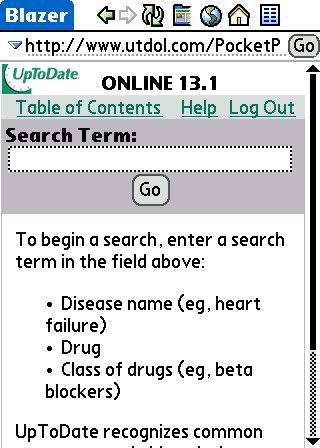
Screenshot using my T5 + SD Wifi card:
Haemoncrules 1.8
I have updated Haemoncrules and it is now version 1.8 with a total of 30 modules
The changes:
- Added a Malignant/Benign Menu filter
- Added Lansky to Performance scores
- Updated PRV Diagnosis
- Added ET Diagnosis
Visit the HaemOncRules Homepage for more details and the download link.
Oh, it's still freeware ;) And as I still don't have a PPC, there still isn't a PPC version, sorry ;)
Getting Medscape articles on your PDA
Medscape is a great and free online resource for medical doctors.
Sometime back, a colleague of mind who uses a palmOne Tungsten|E asked me how to get copies of Medscape articles into his PDA for offline reading.
Well, some of you might be wondering the same thing so I will run through a few solutions for offline reading.
The most important thing is to select the Print option from Medscape: normally an icon which looks like somewhere at the top of the article.
1) Repligo. This is a great product from Cerience. The reader is free but the converter is not free but is very easy to use. Once you install the converter, Repligo will be installed as a "printer driver" so all you do is select the usual File/Print and then Repligo as the printer. You could do this for any thing else including PDF documents by the way.
2)iSilo. This is a popular shareware ebook reader and like repligo has text and image capability as well as great hypertext linking. For Medscape, after selecting the Print option, you need to Save the page as a HTML document. Just choose File/Save Page As from your Browser and select a page to save the HTML document somewhere on your hard drive. Using the free iSiloX converter, you then convert this HTML document into an iSilo compatible pdb file which you can sync to your Palm or install in Palm/Programs/iSilo on your Card.
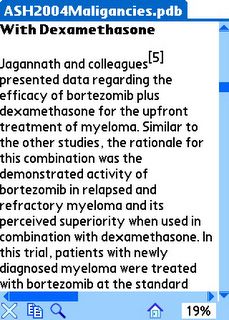
Snapshot of iSilo view of a Medscape article
3)Plucker/Sunrise combo. This third option is completely free. The reader is called Plucker.This is a free offline HTML reader and a great alternative to iSilo. Download the latest (version 1.8).
You need to save the Medscape page as a HTML file as in iSilo above (after selecting the Print page display)
There are several alternatives to convert HTML files but the one I use is Sunrise. It requires Java but is a nice way to convert local or online web pages (and RSS feeds) to Plucker format. You can download Sunrise from Palmgear (latest version is 0.41f) and read more from the Author's webpage
There are other solutions of course, but the above three are relatively easy ways to get Medscape articles with all the text and pictures onto your handheld. So CS Wong, if you are reading this, HTH!
Sometime back, a colleague of mind who uses a palmOne Tungsten|E asked me how to get copies of Medscape articles into his PDA for offline reading.
Well, some of you might be wondering the same thing so I will run through a few solutions for offline reading.
The most important thing is to select the Print option from Medscape: normally an icon which looks like
somewhere at the top of the article.1) Repligo. This is a great product from Cerience. The reader is free but the converter is not free but is very easy to use. Once you install the converter, Repligo will be installed as a "printer driver" so all you do is select the usual File/Print and then Repligo as the printer. You could do this for any thing else including PDF documents by the way.
2)iSilo. This is a popular shareware ebook reader and like repligo has text and image capability as well as great hypertext linking. For Medscape, after selecting the Print option, you need to Save the page as a HTML document. Just choose File/Save Page As from your Browser and select a page to save the HTML document somewhere on your hard drive. Using the free iSiloX converter, you then convert this HTML document into an iSilo compatible pdb file which you can sync to your Palm or install in Palm/Programs/iSilo on your Card.
Snapshot of iSilo view of a Medscape article
3)Plucker/Sunrise combo. This third option is completely free. The reader is called Plucker.This is a free offline HTML reader and a great alternative to iSilo. Download the latest (version 1.8).
You need to save the Medscape page as a HTML file as in iSilo above (after selecting the Print page display)
There are several alternatives to convert HTML files but the one I use is Sunrise. It requires Java but is a nice way to convert local or online web pages (and RSS feeds) to Plucker format. You can download Sunrise from Palmgear (latest version is 0.41f) and read more from the Author's webpage
There are other solutions of course, but the above three are relatively easy ways to get Medscape articles with all the text and pictures onto your handheld. So CS Wong, if you are reading this, HTH!
Saturday, March 05, 2005
New Palm for Gruntdoc
I guess it will happen to all of us at some stage. Your PDA will die on you. Nothing is forever and worse still, due to what I suspect is built-in self-destruct obsolescence, it will die on you sooner than the PDAs made 5 years ago.
Gruntdoc got a T5 to replace his TT. I guess this is good for palmOne since like him (and me for that matter), many are reticent about migrating to the WM2003 platform mainly because we are familiar with PalmOS and also we have invested time, money and software in PalmOS.
The T5 is a decent PDA but it falls short in the aesthetics department. I do wish palmOne will come out with a sexier looking device, and for goodness' sake, please come out with a dual wireless one. You really can't claim to be a "connected organizer" if you remain disconnected from the Wifi world. Although you have the SD Wifi card, it is a pain having to slot it in and out. So c'mon palmOne, wheres the Palm for power users?
Friday, March 04, 2005
Feedback: Switch Story I
Brian S writes in:
Thanks for your feedback Brian. A free Gmail invite goes out to you. Plenty more invitations so do write and share your experience if you have switched from Palm to PPC and vice versa.
As for me, after pestering palmOne with emails detailing my disappointing experience with my T3, the Customer Service Manager agreed to treat my case as "in warranty" and I got an SRO for a replacement. So my dead T3 is now off to palmOne. Well this has been beyond my expectations and it has been nice of palmOne to consider individual pleas like mine. However they could pay heed to better quality control - the T3 is a great design and the T5 by comparison is dull. It just needed better QC and less annoying breakdowns like digitiser issues and screen buzz issues.
I think part of the blame for the declining PDA market is the fact that there aren't many "imaginative" and "enticing" models out there to choose from. Hey, not everyone wants a smartphone with tiny screens and limited Ram/Expandibility. Where are the PDAs for power users? I sure hope palmOne will come up something interesting this year.
So the upside is I still haven't succumbed to the dark side yet ;)
| I also had a cursed Palm T3, which had a defective digitizer. Palm refused to honor the aftermarket Palm extended warranty, but they finally relented after the seventh call to Palm tech support in India. I have become VERY disenchanted with Palm’s customer support, or lack thereof. This was the sixth Palm pda that I have owned. I switched back to Windows Mobile 2003, when I bought a HP Ipaq 4155. This is the seventh Pocket PC that I have owned. I mainly use Skyscape and Tarascon medical reference software. I also occasionally use Medical Wizard’s Netter flash cards for reference and patient teaching. Activesync can be a REAL pain in the butt sometimes. Do frequent backups. |
Thanks for your feedback Brian. A free Gmail invite goes out to you. Plenty more invitations so do write and share your experience if you have switched from Palm to PPC and vice versa.
As for me, after pestering palmOne with emails detailing my disappointing experience with my T3, the Customer Service Manager agreed to treat my case as "in warranty" and I got an SRO for a replacement. So my dead T3 is now off to palmOne. Well this has been beyond my expectations and it has been nice of palmOne to consider individual pleas like mine. However they could pay heed to better quality control - the T3 is a great design and the T5 by comparison is dull. It just needed better QC and less annoying breakdowns like digitiser issues and screen buzz issues.
I think part of the blame for the declining PDA market is the fact that there aren't many "imaginative" and "enticing" models out there to choose from. Hey, not everyone wants a smartphone with tiny screens and limited Ram/Expandibility. Where are the PDAs for power users? I sure hope palmOne will come up something interesting this year.
So the upside is I still haven't succumbed to the dark side yet ;)
Thursday, March 03, 2005
PDE
Well, this week's issue of the NEJM has an article which tells us that what we hold in our hands is not a PDA but a PDE (Personal Digital Educator).
The author, Dr. Cimino talks about the various sources of data - standalaone, synchronisation (ala Avantgo) mode and what I think will become more important in time to come, the wireless mode. There is only so much you can store on the PDA, even if you have that 4GB CF Card, it's always never enough. Eventually we'll be using handheld devices to look up information wirelessly.
I found this bit interesting:
I wish more medical schools could be as innovative as this!
Dr Cimino ends the article with this:
How I wish! In fact what is now known as the new Intern's Palmomental Reflex, (something again first published in the NEJM) should be a reflex all doctors learn to use!!
| "What's his infection sensitive to?" In 1995, getting the answer to this question required a house officer to find an unoccupied computer at the nursing station, sign on, and traverse the necessary screens to get the culture result. Armed with the answer -- say, "levofloxacin" -- she would ask the follow-up question: "What's the renal dosing?" The next step would typically entail a search for a tattered copy of a drug reference manual. In 2000, the house officer still needed to turn to the computer for the first answer, but for the second, she might have skipped the scavenger hunt and pulled out her personal digital assistant (PDA). A few quick taps and scribbles, and she had her answer. |
The author, Dr. Cimino talks about the various sources of data - standalaone, synchronisation (ala Avantgo) mode and what I think will become more important in time to come, the wireless mode. There is only so much you can store on the PDA, even if you have that 4GB CF Card, it's always never enough. Eventually we'll be using handheld devices to look up information wirelessly.
I found this bit interesting:
| The synchronization mode is also being exploited by educators to monitor the clinical experiences of trainees. For example, third-year medical students at Columbia use a case log on their PDAs to collect information about the patients they see. These cases are transferred to a central database, where clerkship directors can review students' encounters to ensure that there is an appropriate mix of cases. The Columbia School of Nursing integrates a patient-tracking log with a variety of decision aids to monitor the extent to which students are providing evidence-based care. |
I wish more medical schools could be as innovative as this!
Dr Cimino ends the article with this:
| In 2005, when the same question arises -- "What's his infection sensitive to?" -- the PDA comes into play immediately (see the figure). A few taps, and the PDA obtains the answer from the clinical-information system: "levofloxacin." Then "What's the renal dosing?" One additional tap on the PDA screen provides the answer. |
How I wish! In fact what is now known as the new Intern's Palmomental Reflex, (something again first published in the NEJM) should be a reflex all doctors learn to use!!
Wednesday, March 02, 2005
Morbidly obese
It's nice to rely your own software when the need arises. The need surely arose when we had to transplant a "morbidly obese" individual with AML. Height 173 cm, Weight over 120 Kg.
The dose of Busulphan (4mg/kg/day) is dependent on Ideal Body Weight (+0.25) so I whipped out Fatcalc (instead of Haemoncrules for a change). The dose difference was huge - more than 100mg a day had we relied on the actual body weight.
Well, I tell my patients that slimming comes as a free package together with the stem cell transplantation so hopefully this guy will slim down after the transplant! ';)
Tuesday, March 01, 2005
Dx/Rx: Heart Failure
Skyscape has revamped their website and the design looks nicer. They also have newly released Dx/Rx: Heart Failure:
| Tightly organized into a super-condensed outline bulleted format, this handy manual details precise, up-to-date information for diagnosis and treatment of Heart Failure. Throughout the reference, tables and figures summarize important clinical data and current professional society recommendations, while salient references direct readers to additional information. Current, quick, and concise, for instant access on the ward or in the clinic! |
Monday, February 28, 2005
Asco PDA Portal
Joined Docsboard (finally hehe) which looks like a great site if you are a Doc with a keen interest in computers and PDAs.
Picked up a useful pointer : Asco has a PDA Portal. Works like Avantgo and is free - so go check it out.
I'm still strongly in the PalmOS camp in case anyone is worried I have defected :P. I am using a palmOne T5 for my daily PDA use. I still am interested in getting a Dell Axim X50v as a second/spare PDA and also to see what the "Darkside" is all about - hopefully I won't get assimilated!
Latest latest news about my dead T3 is that palmOne support has now "escalated" my issue with them to the Customer Service Manager. So hopefully I'll see a better deal than a replacement costing US$125 with a "generous" 3 month warranty....
Sunday, February 27, 2005
Turning to the Dark Side....part II
Well, the dead T3 saga is practically over. palmOne's stand is that since the unit is out of warranty, they will issue a replacement for US$125 and provide a "generous" 3 months warranty on this unit. They can keep it for all I care. It should be at least 6 months warranty given that price and the reliability of a refurbished unit is always in question. I have not had a happy experience with my T3 as I had to replace it twice already.
In preparation for the Dark side, I have switched back to syncing with Outlook instead of Palm Desktop with my T5 (yes, the sole remaining Palm I have, which I have paid good money to palmOne to field test for them).
Eventually when I get my hands on a Dell Axim X50V I can easily migrate my PIM data over. I have identified WM2003 replacements for practically every PDA application I use today so I think the switch can be made. I won't miss Agendus too much as I could rely on Agendus for Windows on the Desktop for clinic use, to manage Patient Appointments. I find Agendus for Windows a far better PIM manager than Outlook and it works on top of Outlook or Palm Desktop and can read PIM data from either source.
Have any of you medical Palm PDA users made the switch from Palm to PPC/WM2003? Care to share your experience/advice/words of wisdom? If you could email me your thoughts and experiences on this matter I'd appreciate it. I also still have alot of Gmail invitations to give out so more FREE Gmail invites for those who write in!
Saturday, February 26, 2005
Pepid Lab Manual
Pepid have launched a new Lab Manual to complement their suite of medical references.
PEPID's new Laboratory Manual includes detailed information on 300 common lab tests. Information for each test includes all of the following sub titles (on applicable tests):
* Critical Values - listed first with links to High and Low Interpretation and symptoms and treatments
* Description - Common use of test, crucial ordering points
* Method Differences - Sensitivity/specificity, screening/confirmation use
* Normal Reference Ranges - Presented in standard and SI units with gender and age differentials. Instant information with links to High and Low interpretation and symptoms and treatments.
* Interpretation High & Interpretation Low - Includes general comments, medical causes, factitious/spurious causes and drug causes with links to symptoms and treatment
* Related Tests - lists commonly related tests, testing strategies, and other considerations
* Equations - links to related PEPID equations/calculators
* Physiology - Underlying processes of substance/metabolite being measured. Lists the origin, function, detrimental effects and excretion.
* Tech Info - Collection methodology and guidelines
Subscribe to:
Posts (Atom)