Skyscape Introduces “Prentice Hall Nurse’s Drug Guide 2006” for Handheld Devices
MARLBOROUGH, MASS. – April 17, 2006 – Skyscape, Inc., the leader in mobile point-of-care decision support solutions, today announced the release of “Prentice Hall Nurse’s Drug Guide 2006” formatted specially for PDAs and smart phones.
“Prentice Hall Nurse’s Drug Guide 2006” is a comprehensive guide providing safe, effective, current, and accurate drug administration information in a quickly accessible format. The fully revised 2006 edition includes the latest drugs approved by the FDA with key nursing implications highlighted throughout. This is the only drug guide to include Prototype Drugs for easier learning.
The “Prentice Hall Nurse’s Drug Guide 2006” is an essential resource for healthcare
practitioners. Skyscape’s intuitive and easy-to-use interface, smARTlink(TM), provides practitioners with instant access to critical information at the point of care. This reference is a powerful decision support tool that helps in reducing errors and enhances the quality of patient care.
The reference is published by Pearson Education - Prentice Hall and joins Skyscape’s portfolio of more than 300 trusted references in over 35 medical specialties. Available for purchase and download from Skyscape at: www.skyscape.com/pndg06pr506. For Palm OS(R) 3.5 or higher, and Windows Mobile(TM) 5/Pocket PC 2002/2003. Cost $45.95; a free trial version is available.
Monday, April 17, 2006
More medical schools requiring PDAs
Yes. PDAs are not dead - they are thriving. At least in the medical community.
More medical schools requiring PDAs (via Palmaddicts)
Some interesting stats
- 28% percent of medical schools require students to have PDAs, according to the most recent survey by the Liaison Committee on Medical Education, the schools‘ accrediting organization.
- any more students use them voluntarily, according to Epocrates‘ research.
- Half of all physicians owned a PDA in 2004, according to the most recent survey by the American Medical Association and Forrester Research Inc.
They should be trained to use PDAs intelligently though. Not solely rely on the Palmomental Reflex!
More medical schools requiring PDAs (via Palmaddicts)
Some interesting stats
- 28% percent of medical schools require students to have PDAs, according to the most recent survey by the Liaison Committee on Medical Education, the schools‘ accrediting organization.
- any more students use them voluntarily, according to Epocrates‘ research.
- Half of all physicians owned a PDA in 2004, according to the most recent survey by the American Medical Association and Forrester Research Inc.
They should be trained to use PDAs intelligently though. Not solely rely on the Palmomental Reflex!
Saturday, April 15, 2006
Toxnet PDA
The National Library of Medicine's TOXNET databases on toxicology, hazardous chemicals, environmental health, and toxic releases is available on your PDA for free, and you don't have to run a separate client program. All you got to do is point your PDA's browser to Toxnet PDA.
LactMed is a more recent addition to Toxnet and is a "peer-reviewed and fully referenced database of drugs to which breastfeeding mothers may be exposed". It's not yet available in the PDA version of Toxnet but I sure hope it will be, as that would be a useful free tool for healthcare workers with PDAs.
LactMed is a more recent addition to Toxnet and is a "peer-reviewed and fully referenced database of drugs to which breastfeeding mothers may be exposed". It's not yet available in the PDA version of Toxnet but I sure hope it will be, as that would be a useful free tool for healthcare workers with PDAs.
Friday, April 14, 2006
New Skyscape releases
Mosby's Nursing PDQ ( MosbyPDQ™ ) 8.0.x
Summary: This reference gives rapid access to hundreds of important facts, formulas, charts, conversions, & more - all necessary to deliver safe & efficient nursing care. It is Practical, Detailed, Quick.
Natural Standard ( NatStan™ ) 8.0.1
Summary: Natural Standard ( NatStan ) - Founded by clinicians and researchers to provide high quality, evidence-based information about complementary and alternative therapies.
Summary: This reference gives rapid access to hundreds of important facts, formulas, charts, conversions, & more - all necessary to deliver safe & efficient nursing care. It is Practical, Detailed, Quick.
Natural Standard ( NatStan™ ) 8.0.1
Summary: Natural Standard ( NatStan ) - Founded by clinicians and researchers to provide high quality, evidence-based information about complementary and alternative therapies.
Thursday, April 13, 2006
Treo as a wireless Holter
From PDA Transmits Data In A Heartbeat
| The soon-to-be-commercialized Bio-Patch Wireless Holter Monitor is a full 12-lead, wireless monitor that measures, records and transmits physiological signals associated with a patient’s cardiovascular system. The Bio-Patch is attached to a patient's chest (where it resembles a large capital-letter “I”) and consists of six electrodes embedded in a disposable bandage-like strip. The Bio-Patch uses the EASI lead placement to capture electrical impulses of the patient's heart and it transmits this information via Bluetooth to the patients Bio-Patch PDA, which initially is a Palm Treo. The Treo receives, records and stores the electrical activity of the patient’s heart. Every two to four hours, the recorded information is sent wirelessly via Cingular’s network to Telzuit’s monitoring station in Orlando, where it then evaluated by a medical professional. The Holter procedure typically lasts between 24 and 48 hours." |
A couple of updates
Spotted in Palmgear:
Davis's Drug Guide with Auto-Updates 2.1
Davis's Drug Guide, has been extensively updated and is now more versatile and portable than ever! Download Unbound's new version of this best-selling drug reference to a PDA for use on the go. Access your Drug Guide on the Web using a desktop computer or an internet-enabled device such as Treo or BlackBerry!
The Little Black Book of Gastroenterology, 2nd Ed
Thoroughly revised and updated, this latest edition provides comprehensive, concise, evidence-based information on the diagnosis and treatment of gastrointestinal and liver disease. The Little Black Book of Gastroenterology is a convenient resource offering quick access to vital information and makes a great reference for solving pressing problems on the ward or in the clinic.
Davis's Drug Guide with Auto-Updates 2.1
Davis's Drug Guide, has been extensively updated and is now more versatile and portable than ever! Download Unbound's new version of this best-selling drug reference to a PDA for use on the go. Access your Drug Guide on the Web using a desktop computer or an internet-enabled device such as Treo or BlackBerry!
The Little Black Book of Gastroenterology, 2nd Ed
Thoroughly revised and updated, this latest edition provides comprehensive, concise, evidence-based information on the diagnosis and treatment of gastrointestinal and liver disease. The Little Black Book of Gastroenterology is a convenient resource offering quick access to vital information and makes a great reference for solving pressing problems on the ward or in the clinic.
Tuesday, April 11, 2006
RSS feeds Update and The Next Small Thing
So how do you get by your daily fill of reading stuff from the Internet - medical or otherwise. I sure hope you are using RSS feeds, 'cos that's the most efficient way to cover blogs, news sites, medical sites, and even some journals which support it.
I still use Plucker and Sunrise (btw, there is a great Sunrise XP tutorial from MobileRead if you want to try it out) on my Treo650 - which is more than enough for me usually since I can take the feeds with me after fetching them every morning, and read then anytime, anywhere.
For realtime RSS feeds, there are PalmOS and PPC newsreaders which will allow you to fetch the feeds as long as you have an Internet connection (via GPRS/Edge or Wifi).
Well the good news is you don't have to resort to running yet another app on your PDA, eating up more precious Ram (something the Treo650 is short of). Well, thanks to tips from Jeff Kirvin in the Treocentral Forums, there are are lots replacements for apps you can run on your PDA using just your browser!
The cue I got from that is to use Bloglines, which has a Mobile version. Here's a snapshot of Bloglines running on my Dell Axim x50v on PIE, showing the BMJ RSS feed:
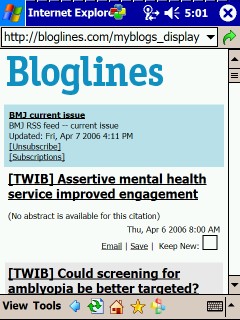
I'm a Bloglines convert! Goodbye Sharpreader, Medreader or whatever RSS reader you use on your PC, and hello Bloglines!
To help you on the way, I have put a small Subscribe to Bloglines button on the left hand panel of this page.
I still use Plucker and Sunrise (btw, there is a great Sunrise XP tutorial from MobileRead if you want to try it out) on my Treo650 - which is more than enough for me usually since I can take the feeds with me after fetching them every morning, and read then anytime, anywhere.
For realtime RSS feeds, there are PalmOS and PPC newsreaders which will allow you to fetch the feeds as long as you have an Internet connection (via GPRS/Edge or Wifi).
Well the good news is you don't have to resort to running yet another app on your PDA, eating up more precious Ram (something the Treo650 is short of). Well, thanks to tips from Jeff Kirvin in the Treocentral Forums, there are are lots replacements for apps you can run on your PDA using just your browser!
The cue I got from that is to use Bloglines, which has a Mobile version. Here's a snapshot of Bloglines running on my Dell Axim x50v on PIE, showing the BMJ RSS feed:
I'm a Bloglines convert! Goodbye Sharpreader, Medreader or whatever RSS reader you use on your PC, and hello Bloglines!
To help you on the way, I have put a small Subscribe to Bloglines button on the left hand panel of this page.
Handbook on Injectable Drugs, 13th Edition
Skyscape Introduces “Handbook on Injectable Drugs, 13th Edition” for Handheld
Devices
MARLBOROUGH, MASS. – April 10, 2006 – Skyscape, Inc., the leader in mobile point-of- care decision support solutions, today announced the release of “Handbook on injectable Drugs, 13th Edition” formatted specially for PDAs and smart phones.
“Handbook on Injectable Drugs, 13th Edition” is a dynamic new mobile tool that makes it quick and easy to check the compatibility of drugs. Once you enter a selected drug product, clear compatibility and stability results are displayed so you can quickly take clinical action based on this comprehensive and trusted guide that that has long been a must-have resource for health care professionals. Over 2,400 reference itations reveal the evidence base for each decision. No other drug reference examines drug stability and compatibility in such extensive detail.
“Handbook on Injectable Drugs, 13th Edition” is an essential resource for healthcare practitioners. Skyscape’s intuitive and easy-to-use interface, smARTlink(TM), provides practitioners with instant access to critical information at the point of care. This reference is a powerful decision support tool that helps in reducing errors and enhances the quality of patient care.
The reference is published by the American Society of Health-System Pharmacists, and joins Skyscape’s portfolio of more than 300 trusted references in over 35 medical specialties.
Available for purchase and download from Skyscape at: www.skyscape.com/HIDPR506. For Palm OS(R) 3.5 or higher, and Windows Mobile(TM) 5/Pocket PC 2002/2003. Cost $49; a free trial version is available.
Devices
MARLBOROUGH, MASS. – April 10, 2006 – Skyscape, Inc., the leader in mobile point-of- care decision support solutions, today announced the release of “Handbook on injectable Drugs, 13th Edition” formatted specially for PDAs and smart phones.
“Handbook on Injectable Drugs, 13th Edition” is a dynamic new mobile tool that makes it quick and easy to check the compatibility of drugs. Once you enter a selected drug product, clear compatibility and stability results are displayed so you can quickly take clinical action based on this comprehensive and trusted guide that that has long been a must-have resource for health care professionals. Over 2,400 reference itations reveal the evidence base for each decision. No other drug reference examines drug stability and compatibility in such extensive detail.
“Handbook on Injectable Drugs, 13th Edition” is an essential resource for healthcare practitioners. Skyscape’s intuitive and easy-to-use interface, smARTlink(TM), provides practitioners with instant access to critical information at the point of care. This reference is a powerful decision support tool that helps in reducing errors and enhances the quality of patient care.
The reference is published by the American Society of Health-System Pharmacists, and joins Skyscape’s portfolio of more than 300 trusted references in over 35 medical specialties.
Available for purchase and download from Skyscape at: www.skyscape.com/HIDPR506. For Palm OS(R) 3.5 or higher, and Windows Mobile(TM) 5/Pocket PC 2002/2003. Cost $49; a free trial version is available.
Sunday, April 09, 2006
MIMS for PalmOS
Last year I mentioned that MIMS Asia has been developing a version for the Pocket PC .
It seems to me that progress has been slow and based on email correspondence with them, I don't think they will ever develop a version for PalmOS.
Well, let's say if someone wanted to create MIMS for PalmOS. Would it be possible? Hypothetically yes, with a bit of hard work but the tools are there. A hypothetical version (like the hypothetical B.N.F) would look like this:
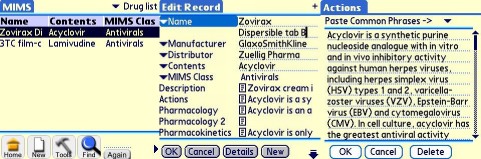
It seems to me that progress has been slow and based on email correspondence with them, I don't think they will ever develop a version for PalmOS.
Well, let's say if someone wanted to create MIMS for PalmOS. Would it be possible? Hypothetically yes, with a bit of hard work but the tools are there. A hypothetical version (like the hypothetical B.N.F) would look like this:
Thursday, April 06, 2006
Free ICD Coding Tool
You can download ICD-9CM Handheld Coding Tool - Version 1.2 with 2006 data for free from PDR.net (via Kidney Notes)
TriageDoc
Looks like medical PDA software authors have found yet another application. TriageDoc by Medical Decisions Software has been released in Palmgear
| Application Description 1. May be used for pre hospital or for in hospital triage. 2. Helps triage by sorting patients by tag color, Revised Trauma Score (RTS), Trauma Score (TS) or elapsed time (ET). 3. Does multiple levels of triage from basic tag color to RTS and ET. This helps improve continuity of care to the next level of triage. 4. Has pre hospital run sheet documentation assistance. From [Start Run] , this docutimer keeps tract of events as you document from the call time to scene findings, extraction factors, history, exam, basic treatments and disposition. Provides run summary based on documentation. 5. Has preliminary assistance with some differential diagnosis and biochemical agent identification if the [ Analysis] button appears as a result of documented findings. 6. Has for each patient a summary screen and if the Analysis button comes up on the summary screen, a tap on it will list most likely to least likely biochemical agent identification.. Not all agents are contained in this application as this shareware version grew out of a research version that was designed and tested by first responders. 7. Once the triage task is done, the information documented and the list of patients triaged in sort order is exported to the Palm Memo Pad for maximum portability-print, beam, HotSync. |
Wednesday, April 05, 2006
Pocket Reference for ALS Providers
Skyscape Introduces “Pocket Reference for ALS Providers, 3rd Edition” for Handheld Devices
MARLBOROUGH, MASS. – April 4, 2006 – Skyscape, Inc., the leader in mobile point-of-care decision support solutions, today announced the release of “Pocket Reference for ALS Providers, 3rd Edition” formatted specially for PDAs and smart phones.
“Pocket Reference for ALS Providers, 3rd Edition” is an indispensable resource for Paramedics and EMS responders. Recently updated, this handy field reference is written specifically for Paramedics and offers the most up-to-date information essential to paramedic care.
“Pocket Reference for ALS Providers, 3rd Edition” is an essential resource for healthcare practitioners. Skyscape’s intuitive and easy-to-use interface, smARTlink™, provides users with instant access to critical information at the point of care. This reference is a powerful decision support tool that helps in reducing errors and enhances the quality of patient care.
The reference is published by Pearson Education - Prentice Hall, and joins Skyscape’s
portfolio of more than 300 trusted references in over 35 medical specialties. Available for purchase and download from Skyscape at: www.skyscape.com/ALSProPR506. For Palm OS® 3.5 or higher, and Windows Mobile™ 5/Pocket PC 2002/2003. Cost $29.95; a free trial version is available.
MARLBOROUGH, MASS. – April 4, 2006 – Skyscape, Inc., the leader in mobile point-of-care decision support solutions, today announced the release of “Pocket Reference for ALS Providers, 3rd Edition” formatted specially for PDAs and smart phones.
“Pocket Reference for ALS Providers, 3rd Edition” is an indispensable resource for Paramedics and EMS responders. Recently updated, this handy field reference is written specifically for Paramedics and offers the most up-to-date information essential to paramedic care.
“Pocket Reference for ALS Providers, 3rd Edition” is an essential resource for healthcare practitioners. Skyscape’s intuitive and easy-to-use interface, smARTlink™, provides users with instant access to critical information at the point of care. This reference is a powerful decision support tool that helps in reducing errors and enhances the quality of patient care.
The reference is published by Pearson Education - Prentice Hall, and joins Skyscape’s
portfolio of more than 300 trusted references in over 35 medical specialties. Available for purchase and download from Skyscape at: www.skyscape.com/ALSProPR506. For Palm OS® 3.5 or higher, and Windows Mobile™ 5/Pocket PC 2002/2003. Cost $29.95; a free trial version is available.
Monday, April 03, 2006
PDAs in the battlefield
I noticed this interesting video of how PDAs and Skyscape medical applications are being used in the battlefields of Iraq (Quicktime format):
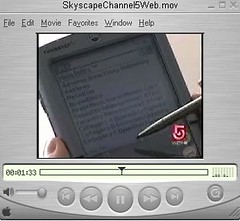
(via Docsboard)
I salute those doctors and nurses serving at the battlefront. I can only imagine how trying it must be. I confess the closest I've got to experiencing "war" has been playing simulations like Battlefield 2. Indeed you might see Corporal Palmdoc in the streets of Karkand as a Medic furiously trying to score points resuscitating fallen comrades ;)
(via Docsboard)
I salute those doctors and nurses serving at the battlefront. I can only imagine how trying it must be. I confess the closest I've got to experiencing "war" has been playing simulations like Battlefield 2. Indeed you might see Corporal Palmdoc in the streets of Karkand as a Medic furiously trying to score points resuscitating fallen comrades ;)
Sunday, April 02, 2006
Spinosum and the Maffucci Syndrome
I was amused to read in Spinosum's blog about how he impressed his colleagues, looking up this obscure Eponym - Maffucci Syndrome - on his PDA.
Just a reminder how useful the freebie Eponyms (for Palm and PPCs) by Andrew Yee is, and of course how vitally useful PDAs are in medical practice today.
There used to be the time when PDAs impressed members of the opposite sex in general, but I can say, they are no longer "chick magnets"... haha...
Just a reminder how useful the freebie Eponyms (for Palm and PPCs) by Andrew Yee is, and of course how vitally useful PDAs are in medical practice today.
There used to be the time when PDAs impressed members of the opposite sex in general, but I can say, they are no longer "chick magnets"... haha...
Back it up
A patient of mine recently lamented the loss of his data on his GSPDA Xplore G88 (a PalmOS phone made in China). This phone does not have an SD slot and he has not been syncing and backing up his phone regularly.
This made me think that perhaps Palm has got it right by moving on to non-volative Ram : you don't lose your data even if the battery runs out. I still remember the bad old days when you notice the charge near critical and you are on a trip and don't have your charger with you. Well those days I relied on backup to SD with utilities like Backupman - this is still my favorite and I am a happy registered user of Backupman. Even with the NVFS, there is a chance you could install some rogue program and result in your Palm going into some endless reset loop. Got your daily backup on SD? No problem. Hard reset and then restore. You're good to go!
I have been using Palm PDAs since 1997 and I am proud to say I have not lost any of my built-in data, the most precious of which is my Contact database.
Message of the day : Back it up! (see also PalmAddicts Back Up)
This made me think that perhaps Palm has got it right by moving on to non-volative Ram : you don't lose your data even if the battery runs out. I still remember the bad old days when you notice the charge near critical and you are on a trip and don't have your charger with you. Well those days I relied on backup to SD with utilities like Backupman - this is still my favorite and I am a happy registered user of Backupman. Even with the NVFS, there is a chance you could install some rogue program and result in your Palm going into some endless reset loop. Got your daily backup on SD? No problem. Hard reset and then restore. You're good to go!
I have been using Palm PDAs since 1997 and I am proud to say I have not lost any of my built-in data, the most precious of which is my Contact database.
Message of the day : Back it up! (see also PalmAddicts Back Up)
The Heart Pod
Spotted in ABC7Chicago :
Well the expanding use of PDAs, medical and otherwise continues to amaze me. Add this one to the list of the Many Many Uses of PDAs!
| One PDA is helping patients like Lonnie Marshall deal with congestive heart failure. That means his heart has lost the ability to pump blood efficiently. "Couldn't make it to the mailbox and back without stopping along the way sucking for air and get in the house," said Lonnie Marshall, heart patient. After antibiotics and steroids failed, Lonnie began taking diuretic drugs to rid the body of extra fluid, and then he became the first American patient to test the "Heart Pod." It's a PDA that measures fluid. "There's a wire that goes into the heart and a very small can which can be used to extract information," said Dr. William Abraham, heart surgeon, Ohio St. University Medical Center. The wire and can are surgically implanted. Then a PDA device reads fluid levels telling patients how much medicine to take. "We can adjust the dose of the patient's water pills to alleviate the congestion before they get into trouble and before they end up in the emergency department or the hospital," said Abraham. |
Well the expanding use of PDAs, medical and otherwise continues to amaze me. Add this one to the list of the Many Many Uses of PDAs!
Saturday, April 01, 2006
PalmPDF updated
PalmPDF, the great free PDF reader for Palm has been updated to version 1.2
I'll be trying this version as I noticed a bug with the earlier version where if you try to reduce the Ram consumption by selecting the Move to Card Option, there is an increased instability in my Treo, in particular when running Backupman. With the entire app in Ram it's OK. Hope this version fixes things.
Anyway I use PalmPDF to read by articles (mostly Journal articles) on my Treo. Simply great!
I'll be trying this version as I noticed a bug with the earlier version where if you try to reduce the Ram consumption by selecting the Move to Card Option, there is an increased instability in my Treo, in particular when running Backupman. With the entire app in Ram it's OK. Hope this version fixes things.
Anyway I use PalmPDF to read by articles (mostly Journal articles) on my Treo. Simply great!
Friday, March 31, 2006
Clinical Anesthesiology from USBMIS
USBMIS has gone to great lengths to produce a well-informed, consistently organized, and user-friendly application for your PDA. Clinical Anesthesiology is a succinct overview of the basic concepts and clinical considerations in the anesthetic management of patients, and is a must-have for any anesthesiologist or trainee in this specialty.
Check out these valuable features:
* Updates to all chapters reflecting the latest advances in practice
* Case discussions demonstrate application of the contents
* Key Terms and Topics provide a quick guide to subject matter usually contained on written exams
* Tables and figures allow easy comprehension of complex material
* Key Concepts help you focus on truly important themes that constitute the core understanding of anesthesiology
* Comprehensive index facilitates quick searching
* Bookmarks personalize your application for the information you access most frequently
Check out these valuable features:
* Updates to all chapters reflecting the latest advances in practice
* Case discussions demonstrate application of the contents
* Key Terms and Topics provide a quick guide to subject matter usually contained on written exams
* Tables and figures allow easy comprehension of complex material
* Key Concepts help you focus on truly important themes that constitute the core understanding of anesthesiology
* Comprehensive index facilitates quick searching
* Bookmarks personalize your application for the information you access most frequently
Epocrates Doctors Day offer
March 30 is Doctors Day (Happy Doctors Day!) and Epocrates is having a special offer:
Subscribe to ALL of their mobile products for just $75 AND receive a FREE subscription to Epocrates® Online Premium! That's a $209.98 value for just $75. Big discount!
Subscribe to ALL of their mobile products for just $75 AND receive a FREE subscription to Epocrates® Online Premium! That's a $209.98 value for just $75. Big discount!
Medical Texting
The Ectopic Brain blogs about Health Service Needs More SMS. Just yesterday a colleague of mine emailed me for help as he is experiencing issues with his Palm T5 and his t630 phone, being unable to retrieve SMSes from the phone. This just goes to show you how dependent we have become on SMSes. The telcos are very happy too for over here and I'm sure all over the world where "texting" is done, they are making $$$$$$$$$.
What I like about SMSes is that the messages are unobtrusive. They don't disturb you in the middle of a conversation or worse still in the middle of a procedure like a phone call. They are also usually cheaper then a voice call and the best part is the data is kept on your phone so you can retrieve the information later.
What I don't like is smtms d msg cn b cryptc n diff 2 undrstnd. No fear, you can always refer to SMS Dicitonaries if you are befuddled by the SMS shorthand.
I use it everyday and I am very impressed with the Treo650's SMS program as the "threaded conversation" display is very user friendly. I am trying to persuade my colleague to go convergence too and he won't have anymore problems with getting the correct phone drivers.
A sample message I sent yesterday:
Me2DrL: Got a patient Mr X in Rm 123 for a PICC. Can you help?
DrL2Me: Sure. Can put it in this afternoon
Later in the day DrL SMSed "PICC in successfully"
I do communicate with patients via SMS too and in fact if you don't want to be disturbed by phone calls from patients, you could insist they send SMSs only (cellphones are pretty ubiquitous these days anyway). You could use software for your Treo like Ringo or CallFilter to screen calls from individuals or contact groups (e.g. Patients) and divert the calls to a voice message which tells them to send an SMS instead!
There is a cheaper way to communicate via text with your smartphone but I'll leave that for another blogpost....
What I like about SMSes is that the messages are unobtrusive. They don't disturb you in the middle of a conversation or worse still in the middle of a procedure like a phone call. They are also usually cheaper then a voice call and the best part is the data is kept on your phone so you can retrieve the information later.
What I don't like is smtms d msg cn b cryptc n diff 2 undrstnd. No fear, you can always refer to SMS Dicitonaries if you are befuddled by the SMS shorthand.
I use it everyday and I am very impressed with the Treo650's SMS program as the "threaded conversation" display is very user friendly. I am trying to persuade my colleague to go convergence too and he won't have anymore problems with getting the correct phone drivers.
A sample message I sent yesterday:
Me2DrL: Got a patient Mr X in Rm 123 for a PICC. Can you help?
DrL2Me: Sure. Can put it in this afternoon
Later in the day DrL SMSed "PICC in successfully"
I do communicate with patients via SMS too and in fact if you don't want to be disturbed by phone calls from patients, you could insist they send SMSs only (cellphones are pretty ubiquitous these days anyway). You could use software for your Treo like Ringo or CallFilter to screen calls from individuals or contact groups (e.g. Patients) and divert the calls to a voice message which tells them to send an SMS instead!
There is a cheaper way to communicate via text with your smartphone but I'll leave that for another blogpost....
Tuesday, March 21, 2006
New Skyscape releases
You might be interested in these new Skyscape releases:
Internal Medicine On Call, 4th Ed. Special Mobile/Desktop Bundle
A concise, portable reference that focuses on the evaluation and treatment of over 60 of the most common internal medicine on-call problems.
The Breastfeeding Answer Book - Pocket Guide Edition
Complete and up to date information for those who help mothers breastfeed.
The Harriet Lane Handbook, NEW 17th Ed.
The pediatrician's reference of choice for more than 50 years. Completely revised and updated with new interactive flowcharts and nearly 600 integrated weight-based dosing calculators, Skyscape's Harriet Lane Handbook sets a new standard as the essential decision support tool for anyone who treats children.
Handbook on Injectable Drugs, 13th Ed.
Written by Lawrence A. Trissel, ASHP's Handbook on Injectable Drugs is a dynamic new mobile tool that makes it quick and easy to check on the compatibility of drugs.
Emergency Medicine Manual, 6th Ed.
The best-selling pocket reference in emergency medicine covers step-by-step treatments, coverage of bioterrorism and more.
Internal Medicine On Call, 4th Ed. Special Mobile/Desktop Bundle
A concise, portable reference that focuses on the evaluation and treatment of over 60 of the most common internal medicine on-call problems.
The Breastfeeding Answer Book - Pocket Guide Edition
Complete and up to date information for those who help mothers breastfeed.
The Harriet Lane Handbook, NEW 17th Ed.
The pediatrician's reference of choice for more than 50 years. Completely revised and updated with new interactive flowcharts and nearly 600 integrated weight-based dosing calculators, Skyscape's Harriet Lane Handbook sets a new standard as the essential decision support tool for anyone who treats children.
Handbook on Injectable Drugs, 13th Ed.
Written by Lawrence A. Trissel, ASHP's Handbook on Injectable Drugs is a dynamic new mobile tool that makes it quick and easy to check on the compatibility of drugs.
Emergency Medicine Manual, 6th Ed.
The best-selling pocket reference in emergency medicine covers step-by-step treatments, coverage of bioterrorism and more.
Food Pyramid 2.6
Food Pyramid 2.6 has been updated
 Application Description Application DescriptionThis simple program is based on the USDA's food guide pyramid. It will remind you that what kinds of food you should eat everyday. You can sort the records by date and large notes field for input additional information. At the end of each day you can put in the daily rating that you think you should get and motivate yourself to do even better tomorrow. |
Skyscape Achieves Major Milestone
Press Release
Skyscape Inc. Achieves Major Milestone Surpassing 500,000 Medical Professionals Using Its Mobile Point-Of-Care Solutions
MARLBOROUGH, MASS. – March 20, 2006 – Skyscape Inc., the firm that pioneered in-context integrated medical references, has achieved an important new milestone by surpassing 500,000 registered medical professionals using its library of mobile medical decision support tools.
A half-million nurses, physicians and allied health professionals are using Skyscape solutions on PDAs, smart phones, Tablet PCs and desktop PCs for fast and accurate diagnosis, treatment and prescribing support at the point-of-care, or wherever decision support is required, said Sandeep Shah, Skyscape founder and CEO.
“New medical evidence and other breaking information is released so rapidly that medical professionals and students must use the latest technology to stay on top of the daily wave of new information which is so critical to them and their patients,” Shah said.
While 1 in 2 physicians already use handhelds in their daily practice, Shah says their utilization – and the number of Skyscape users – will continue, driven by the growth of evidence-based medicine and electronic medical records – as well as increased wireless accessibility.
Recognizing the benefits, medical centers, such as Children’s Hospital Boston, and educational institutions, such as Vanderbilt University, are deploying or otherwise supporting the use of handheld medical decision support software by their doctors, nurses, students and instructors.
“Individual practitioners and institutions alike are realizing the benefits that Skyscape technology can bring in terms of reduced medical errors and better care,” Shah said.
A recent Skyscape survey of more than 2,800 medical professionals credited PDA-based
decision support tools with helping them to provide better and more efficient patient care. A majority cited handheld tools as “critical” to their daily practice and reported that the decision support and reference solutions enabled them to reduce potential medical errors, provide more medical care and assist more patients.
"Today, medical professionals can be literally 'up to the minute' with information delivered anywhere they need it," Shah said. “Handheld PDAs, smart phones and tablet PCs are an ideal use of technology for providing instant mobile access to general and specialty reference titles, clinical and drug-dosing calculators, ICD-9 coding, treatment guidelines and other decision support solutions – all updateable via a desktop or wireless Internet connection.”
Today, Skyscape offers more than 300 such decision support resources – the largest library available – covering over 30 medical specialties. Skyscape’s patented smARTlink™ technology provides interlinked clinical content between its portfolio titles as well as with leading mobile medical computing solutions such as MedAptus, MercuryMD and PatientKeeper. Skyscape products are available for Palm OS® and Windows® Mobile Pocket PC handheld PDAs and smart phones and Windows® desktop, laptops and Tablet PCs.
Skyscape Inc. is headquarted in Marlborough, Mass., and is on the Net at www.skyscape.com.
Skyscape Inc. Achieves Major Milestone Surpassing 500,000 Medical Professionals Using Its Mobile Point-Of-Care Solutions
MARLBOROUGH, MASS. – March 20, 2006 – Skyscape Inc., the firm that pioneered in-context integrated medical references, has achieved an important new milestone by surpassing 500,000 registered medical professionals using its library of mobile medical decision support tools.
A half-million nurses, physicians and allied health professionals are using Skyscape solutions on PDAs, smart phones, Tablet PCs and desktop PCs for fast and accurate diagnosis, treatment and prescribing support at the point-of-care, or wherever decision support is required, said Sandeep Shah, Skyscape founder and CEO.
“New medical evidence and other breaking information is released so rapidly that medical professionals and students must use the latest technology to stay on top of the daily wave of new information which is so critical to them and their patients,” Shah said.
While 1 in 2 physicians already use handhelds in their daily practice, Shah says their utilization – and the number of Skyscape users – will continue, driven by the growth of evidence-based medicine and electronic medical records – as well as increased wireless accessibility.
Recognizing the benefits, medical centers, such as Children’s Hospital Boston, and educational institutions, such as Vanderbilt University, are deploying or otherwise supporting the use of handheld medical decision support software by their doctors, nurses, students and instructors.
“Individual practitioners and institutions alike are realizing the benefits that Skyscape technology can bring in terms of reduced medical errors and better care,” Shah said.
A recent Skyscape survey of more than 2,800 medical professionals credited PDA-based
decision support tools with helping them to provide better and more efficient patient care. A majority cited handheld tools as “critical” to their daily practice and reported that the decision support and reference solutions enabled them to reduce potential medical errors, provide more medical care and assist more patients.
"Today, medical professionals can be literally 'up to the minute' with information delivered anywhere they need it," Shah said. “Handheld PDAs, smart phones and tablet PCs are an ideal use of technology for providing instant mobile access to general and specialty reference titles, clinical and drug-dosing calculators, ICD-9 coding, treatment guidelines and other decision support solutions – all updateable via a desktop or wireless Internet connection.”
Today, Skyscape offers more than 300 such decision support resources – the largest library available – covering over 30 medical specialties. Skyscape’s patented smARTlink™ technology provides interlinked clinical content between its portfolio titles as well as with leading mobile medical computing solutions such as MedAptus, MercuryMD and PatientKeeper. Skyscape products are available for Palm OS® and Windows® Mobile Pocket PC handheld PDAs and smart phones and Windows® desktop, laptops and Tablet PCs.
Skyscape Inc. is headquarted in Marlborough, Mass., and is on the Net at www.skyscape.com.
Monday, March 20, 2006
Patient management software update
My favorite patient management software for the Palm has been updated again.
What is it? Why, Iambic's Agendus Pro of course :)
I'll elaborate a little later on but I use Agendus extensively in my daily work and it works fine for me to keep track of my patients, patient and work related tasks and notes and of course my appointments.
Check out the new features
What is it? Why, Iambic's Agendus Pro of course :)
I'll elaborate a little later on but I use Agendus extensively in my daily work and it works fine for me to keep track of my patients, patient and work related tasks and notes and of course my appointments.
Check out the new features
Sunday, March 19, 2006
More medical schools requiring PDAs
In effort to improve care, more medical schools requiring PDAs (via Palmaddicts)
Well, these medical schools have got it right IMO. I have yet to see any of the medical schools where I live make PDAs compulsory. However I do know of many medical students here who use PDAs on their own accord. It may not be compulsory but once you use one, you wonder how you managed without one before.
| Brown recently joined a growing number of medical and nursing schools that require students to buy and use PDAs. Faculty and students say the technology saves time and helps them provide better care, in addition to reducing medical errors. Drug references and diagnostic programs can be stored on them, giving physicians information at their fingertips. "Let's face it, it's impossible to get all this stuff straight in your mind and memorize it," said Art Frazzano, associate dean of medicine at Brown. The University of Rhode Island College of Nursing also began requiring PDAs this year for some students. One goal is to teach students the value of up-to-date information in a field that is rapidly changing, assistant professor Laurie Lauzon Clabo said. "If we had students buy a book, by the time the book hits the bookstore, it's outdated," Lauzon Clabo said. "And with using PDAs, they can update their software weekly." |
Well, these medical schools have got it right IMO. I have yet to see any of the medical schools where I live make PDAs compulsory. However I do know of many medical students here who use PDAs on their own accord. It may not be compulsory but once you use one, you wonder how you managed without one before.
Shortcut tip for your Palm
Miss using Shortcuts for your Treo650?
Well there is a freeware replacement called Shortcut5
Shortcut5 appears in your Preference Panel and you can set your definitions there.
For example I defined a shortcut for "admission"
Name:adm (note you don't put the "." when defining the name, only when you call up the shortcut)
Shortcut:
admission
So in Agendus when I am typing my meeting notes for a patient, I just enter
.adm
and the text automagically becomes "admission"
For the Datestamp and special system shortcuts there are some codes.
E.g. for the Datestamp, the shortcut I define
.ds as the shortcut for Datestamp
the Shortcut code is : @@ds
You can define long phrases and multiline text too if you like (e.g. simple templates)
For example I define a patient template
.pt
as
Diagnosis:
Referring:
Medication:
Follow-up:
and the above text will appear in the notes for me to fill in the blanks after the ":"
You can use Shortcuts wherever you need to enter text e.g. Memopad. It also works in Documents2Go.
Really powerful. And free
Well there is a freeware replacement called Shortcut5
Shortcut5 appears in your Preference Panel and you can set your definitions there.
For example I defined a shortcut for "admission"
Name:adm (note you don't put the "." when defining the name, only when you call up the shortcut)
Shortcut:
admission
So in Agendus when I am typing my meeting notes for a patient, I just enter
.adm
and the text automagically becomes "admission"
For the Datestamp and special system shortcuts there are some codes.
E.g. for the Datestamp, the shortcut I define
.ds as the shortcut for Datestamp
the Shortcut code is : @@ds
You can define long phrases and multiline text too if you like (e.g. simple templates)
For example I define a patient template
.pt
as
Diagnosis:
Referring:
Medication:
Follow-up:
and the above text will appear in the notes for me to fill in the blanks after the ":"
You can use Shortcuts wherever you need to enter text e.g. Memopad. It also works in Documents2Go.
Really powerful. And free
Friday, March 17, 2006
Memoleaf II
Back in 2004, I mentioned using Memoleaf as your "peripheral brain".
You might be interested to know that Memoleaf has recently been updated in Palmgear. Version 4.3 adds even more features and from version 4.2 onwards, the Treo's Dpad navigation is well supported.
So if you are keeping your clinical notes in a haphazard fashion in your Palm's Memo, get organized today! Get Memoleaf!
You might be interested to know that Memoleaf has recently been updated in Palmgear. Version 4.3 adds even more features and from version 4.2 onwards, the Treo's Dpad navigation is well supported.
So if you are keeping your clinical notes in a haphazard fashion in your Palm's Memo, get organized today! Get Memoleaf!
Thursday, March 16, 2006
Pulmonary Functions and Vital Capacity Calculator
RPN CalcSeries Pulmonary Functions and Vital Capacity Calculator 1.0 has been released in Palmgear.
Application Description:
The pulmonary function and vital capacity calculator provides computations of the predicted and percent predicted values for:
• Vital Capacity (VC)
• Forced Expiratory Volume after 1 second (FEV1)
• Maximum Exploratory Flow Rate (MEFR)
• Maximum Ventilatory Volume after 12 seconds (MVV12)
• Residual Volume (RV)
• Total Lung Capacity (TLC)
• Functional Residual Capacity (FRC)
• Forced Expiratory Flow from 25% to 75% (FEF)
• on-line User Guide
• Hi-Resolution (320x480) support
• User-friendly interface
• RPN stack display
• 90 independent storage registers
• Upgrades / updates are life-time free of charge
• Many examples are provided to teach using the calculator
- Calculations are performed for either male or female patients, given the patient's height and age. Data inputs are patient's height (in either ,metric or English units) and age in years.
- This calculator also performs computations of body surface area (BSA) by either Dubois or Boyd formula, allowing your choice of the preferred method. If cardiac output (CO) is known, cardiac index (CI) may also be calculated. Data inputs are patient's height and weight, in either metric or English units, and if desired, the cardiac output.

Application Description:
The pulmonary function and vital capacity calculator provides computations of the predicted and percent predicted values for:
• Vital Capacity (VC)
• Forced Expiratory Volume after 1 second (FEV1)
• Maximum Exploratory Flow Rate (MEFR)
• Maximum Ventilatory Volume after 12 seconds (MVV12)
• Residual Volume (RV)
• Total Lung Capacity (TLC)
• Functional Residual Capacity (FRC)
• Forced Expiratory Flow from 25% to 75% (FEF)
• on-line User Guide
• Hi-Resolution (320x480) support
• User-friendly interface
• RPN stack display
• 90 independent storage registers
• Upgrades / updates are life-time free of charge
• Many examples are provided to teach using the calculator
- Calculations are performed for either male or female patients, given the patient's height and age. Data inputs are patient's height (in either ,metric or English units) and age in years.
- This calculator also performs computations of body surface area (BSA) by either Dubois or Boyd formula, allowing your choice of the preferred method. If cardiac output (CO) is known, cardiac index (CI) may also be calculated. Data inputs are patient's height and weight, in either metric or English units, and if desired, the cardiac output.
Wednesday, March 15, 2006
USBMIS Sale of the Week
USBMIS Sale of the Week is on again:
Purchase Schwartz Principles of Surgery or Just the Facts in Emergency Medicine this week, March 13 – March 19, and save. Purchase both applications and save BIG!
Schwartz Principles of Surgery is one of the world's most well known references in general surgery. Just the Facts in Emergency Medicine is one of the most valuable and trusted PDA references available for this area of specialty. Now, and for a limited time only, purchase both valuable applications and save more.
* Save 10% - Schwartz Principles of Surgery.
* Save 10% - Just the Facts in Emergency Medicine.
* Save 20% Off Each - Buy Schwartz Principles of Surgery and Just the Facts in Emergency Medicine and save BIG.
For more details, visit www.usbmis.com
Purchase Schwartz Principles of Surgery or Just the Facts in Emergency Medicine this week, March 13 – March 19, and save. Purchase both applications and save BIG!
Schwartz Principles of Surgery is one of the world's most well known references in general surgery. Just the Facts in Emergency Medicine is one of the most valuable and trusted PDA references available for this area of specialty. Now, and for a limited time only, purchase both valuable applications and save more.
* Save 10% - Schwartz Principles of Surgery.
* Save 10% - Just the Facts in Emergency Medicine.
* Save 20% Off Each - Buy Schwartz Principles of Surgery and Just the Facts in Emergency Medicine and save BIG.
For more details, visit www.usbmis.com
Handhelds in the health literature
Assessment of Clinical Tools
Bochicchio GV, Smit PA, Moore R, Bochicchio K, Auwaerter P, Johnson SB, Scalea T, Bartlett JG; POC-IT Group.
Pilot study of a web-based antibiotic decision management guide.
J Am Coll Surg. 2006 Mar;202(3):459-67. Epub 2006 Jan 19.
... Little is known about the impact of mobile medical information tools on physician learning or improvement in decision-making.
Handhelds in Patient Care & Management
Rudkin SE, Langdorf MI, Macias D, Oman JA, Kazzi AA.
Personal digital assistants change management more often than paper texts and foster patient confidence.
Eur J Emerg Med. 2006 Apr;13(2):92-6.
... Personal digital assistants are feasible in an academic emergency department and change management more often than texts. EMRs accessed personal digital assistants more often than paper texts. Patient perceptions of physicians who use personal digital assistants are neutral or favorable....
Kearney N, Kidd L, Miller M, Sage M, Khorrami J, McGee M, Cassidy J, Niven K, Gray P.
Utilising handheld computers to monitor and support patients receiving chemotherapy: results of a UK-based feasibility study.
Support Care Cancer. 2006 Mar 9; [Epub ahead of print]
... Recent changes in cancer service provision mean that many patients spend a limited time in hospital and therefore experience and must cope with and manage treatment-related side effects at home. Information technology can provide innovative solutions in promoting patient care through information provision, enhancing communication, monitoring treatment-related side effects and promoting self-care. ...
Hanauer DA, Wentzell K, Tovar A, Zeuhlke J, Kumar V, Laffel LM.
Parent and youth assessments of a handheld wireless device to enhance diabetes mellitus management.
Arch Pediatr Adolesc Med. 2006 Mar;160(3):321.
... Diabetes mellitus is a complex disease that requires both the patient and the family to focus on many medical management tasks such as checking blood glucose (BG) levels and administering insulin. Careful adherence to these tasks can often result in better outcomes.1 Several studies have shown that the use of emerging technologies by adolescents and youths can have a positive impact on diabetes care2 and reduce healthcare utilization without adversely affecting outcomes.3 It is becoming increasingly important to explore both interest in and usability of patient-centered implementations using new tools to determine how best to engage hard-to-reach populations such as youths, especially with the proliferation of wireless transmission technologies. ...
Jamison RN, Raymond SA, Slawsby EA, McHugo GJ, Baird JC.
Pain Assessment in Patients With Low Back Pain: Comparison of Weekly Recall and Momentary Electronic Data.
J Pain. 2006 Mar;7(3):192-199.
...Past research has shown that electronic diaries improve the timeliness of receipt of data, contribute to higher rates of compliance, and are preferred by patients over paper diaries, and this research suggests that electronic diaries that capture current pain at the moment of reporting result in more reliable ratings than recalled pain ratings. ...
Handhelds in World Health
Drury P.
The eHealth agenda for developing countries.
World Hosp Health Serv. 2005;41(4):38-40.
... developing countries can fully exploit the potential of handheld computers and wireless connectivity ...
--
MJ Stoddard
Bochicchio GV, Smit PA, Moore R, Bochicchio K, Auwaerter P, Johnson SB, Scalea T, Bartlett JG; POC-IT Group.
Pilot study of a web-based antibiotic decision management guide.
J Am Coll Surg. 2006 Mar;202(3):459-67. Epub 2006 Jan 19.
... Little is known about the impact of mobile medical information tools on physician learning or improvement in decision-making.
Handhelds in Patient Care & Management
Rudkin SE, Langdorf MI, Macias D, Oman JA, Kazzi AA.
Personal digital assistants change management more often than paper texts and foster patient confidence.
Eur J Emerg Med. 2006 Apr;13(2):92-6.
... Personal digital assistants are feasible in an academic emergency department and change management more often than texts. EMRs accessed personal digital assistants more often than paper texts. Patient perceptions of physicians who use personal digital assistants are neutral or favorable....
Kearney N, Kidd L, Miller M, Sage M, Khorrami J, McGee M, Cassidy J, Niven K, Gray P.
Utilising handheld computers to monitor and support patients receiving chemotherapy: results of a UK-based feasibility study.
Support Care Cancer. 2006 Mar 9; [Epub ahead of print]
... Recent changes in cancer service provision mean that many patients spend a limited time in hospital and therefore experience and must cope with and manage treatment-related side effects at home. Information technology can provide innovative solutions in promoting patient care through information provision, enhancing communication, monitoring treatment-related side effects and promoting self-care. ...
Hanauer DA, Wentzell K, Tovar A, Zeuhlke J, Kumar V, Laffel LM.
Parent and youth assessments of a handheld wireless device to enhance diabetes mellitus management.
Arch Pediatr Adolesc Med. 2006 Mar;160(3):321.
... Diabetes mellitus is a complex disease that requires both the patient and the family to focus on many medical management tasks such as checking blood glucose (BG) levels and administering insulin. Careful adherence to these tasks can often result in better outcomes.1 Several studies have shown that the use of emerging technologies by adolescents and youths can have a positive impact on diabetes care2 and reduce healthcare utilization without adversely affecting outcomes.3 It is becoming increasingly important to explore both interest in and usability of patient-centered implementations using new tools to determine how best to engage hard-to-reach populations such as youths, especially with the proliferation of wireless transmission technologies. ...
Jamison RN, Raymond SA, Slawsby EA, McHugo GJ, Baird JC.
Pain Assessment in Patients With Low Back Pain: Comparison of Weekly Recall and Momentary Electronic Data.
J Pain. 2006 Mar;7(3):192-199.
...Past research has shown that electronic diaries improve the timeliness of receipt of data, contribute to higher rates of compliance, and are preferred by patients over paper diaries, and this research suggests that electronic diaries that capture current pain at the moment of reporting result in more reliable ratings than recalled pain ratings. ...
Handhelds in World Health
Drury P.
The eHealth agenda for developing countries.
World Hosp Health Serv. 2005;41(4):38-40.
... developing countries can fully exploit the potential of handheld computers and wireless connectivity ...
--
MJ Stoddard
Tuesday, March 14, 2006
Advanced Nursing Fellowship Program uses Skyscape
Press release:
St. David’s Healthcare Partnership & Austin Community College Deploy Skyscape PDA-Based Medical References in Advanced Nursing Fellowship Program
AUSTIN, TEXAS and MARLBOROUGH, MASS. – March 13, 2006 – Armed with Skyscape medical references on their PDAs, nurses at St. David’s HealthCare Partnership in Austin, Texas, are delivering more efficient, effective, and timely care to patients. The Skyscape mobile medical references are supporting an advanced nursing fellowship program conducted by Austin Community College for the healthcare system.
Program consultant Dr. Susan Smith believes PDAs loaded with mobile medical references are transforming the nursing profession, helping to deliver more efficient and effective patient care.
The institutions received a $2 million U.S. Department of Labor grant as part of the Bush Administration's High Growth Job Training Initiative. About 70 registered nurses participate as fellows in the program, plus clinical coaches serve as expert resources to the fellows.
Under the program, in its second year, the funding is used for the purchase of 120 PDAs for the nurse participants and the clinical coaches.
The nurse participants and their coaches are given Dell PDAs pre-loaded with four popular Skyscape reference titles.
The students are provided instructions on the use of PDAs and how to access the pre-loaded Skyscape nursing reference software, but most participants taught themselves how to use the devices.
“Let’s say someone is questioning a medication, or there is a change in a patient’s
condition, or a laboratory result comes back that needs review, the nurse may need to do fast research before calling the physician to tell them what might be happening,” said Smith. “Our PDAs and their Skyscape medical references really facilitate a much quicker reaction time. Plus, it puts the information at the practitioner’s finger tips. The nurse can respond faster to the physician, or someone else, when using the PDA, instead of returning to the nursing station to reference a medical book,” she said.
Skyscape is the leading provider of medical references formatted specially for mobile
devices. The four Skyscape references purchased were very familiar to the students and covered a broad scope of nursing requirements. “Taber’s Medical Dictionary is a nationally known reference; Davis’ Drug Guide for Nurses and ABCs of Interpretive Laboratory Data are very popular; and RNFastFacts (Nurse’s Fast Facts: The Only Book You Need for Clinicals, 2nd edition) was used and recommended by another agency,” said Smith. “Also, the content covered the age span and specialty areas of Medical-Surgical, Gerontological Care, Maternal Infant, Pediatric, Mental health, Long Term Care, Home Health Care, Nutrition, and Emergency and Critical Care.”
“The grant is a unique opportunity to try to shorten or measure a nurse’s transition from novice toward expert,” said Smith. “We are trying to shorten that transition period by applying different educational strategies. This is one opportunity to demonstrate the value of hand-held computers and mobile medical references at the bedside,” she said.
--
Now that's exploiting a large untapped market - the nurses. I know of very very few nurses myself who use PDAs. The only one I helped set up a PDA wanted to use it to access her Bible and mostly non-medical stuff! I did try to get one of my nurses here to use a PDA as a data collection tool but that plan fizzled out too.
I think it's a mental block or something!
St. David’s Healthcare Partnership & Austin Community College Deploy Skyscape PDA-Based Medical References in Advanced Nursing Fellowship Program
AUSTIN, TEXAS and MARLBOROUGH, MASS. – March 13, 2006 – Armed with Skyscape medical references on their PDAs, nurses at St. David’s HealthCare Partnership in Austin, Texas, are delivering more efficient, effective, and timely care to patients. The Skyscape mobile medical references are supporting an advanced nursing fellowship program conducted by Austin Community College for the healthcare system.
Program consultant Dr. Susan Smith believes PDAs loaded with mobile medical references are transforming the nursing profession, helping to deliver more efficient and effective patient care.
The institutions received a $2 million U.S. Department of Labor grant as part of the Bush Administration's High Growth Job Training Initiative. About 70 registered nurses participate as fellows in the program, plus clinical coaches serve as expert resources to the fellows.
Under the program, in its second year, the funding is used for the purchase of 120 PDAs for the nurse participants and the clinical coaches.
The nurse participants and their coaches are given Dell PDAs pre-loaded with four popular Skyscape reference titles.
The students are provided instructions on the use of PDAs and how to access the pre-loaded Skyscape nursing reference software, but most participants taught themselves how to use the devices.
“Let’s say someone is questioning a medication, or there is a change in a patient’s
condition, or a laboratory result comes back that needs review, the nurse may need to do fast research before calling the physician to tell them what might be happening,” said Smith. “Our PDAs and their Skyscape medical references really facilitate a much quicker reaction time. Plus, it puts the information at the practitioner’s finger tips. The nurse can respond faster to the physician, or someone else, when using the PDA, instead of returning to the nursing station to reference a medical book,” she said.
Skyscape is the leading provider of medical references formatted specially for mobile
devices. The four Skyscape references purchased were very familiar to the students and covered a broad scope of nursing requirements. “Taber’s Medical Dictionary is a nationally known reference; Davis’ Drug Guide for Nurses and ABCs of Interpretive Laboratory Data are very popular; and RNFastFacts (Nurse’s Fast Facts: The Only Book You Need for Clinicals, 2nd edition) was used and recommended by another agency,” said Smith. “Also, the content covered the age span and specialty areas of Medical-Surgical, Gerontological Care, Maternal Infant, Pediatric, Mental health, Long Term Care, Home Health Care, Nutrition, and Emergency and Critical Care.”
“The grant is a unique opportunity to try to shorten or measure a nurse’s transition from novice toward expert,” said Smith. “We are trying to shorten that transition period by applying different educational strategies. This is one opportunity to demonstrate the value of hand-held computers and mobile medical references at the bedside,” she said.
--
Now that's exploiting a large untapped market - the nurses. I know of very very few nurses myself who use PDAs. The only one I helped set up a PDA wanted to use it to access her Bible and mostly non-medical stuff! I did try to get one of my nurses here to use a PDA as a data collection tool but that plan fizzled out too.
I think it's a mental block or something!
Monday, March 13, 2006
Advanced calculator tip
This thread in the MPC forums reminds me to blog about a feature in your Treo650 or newer Palm like the T5/TX/Lifedrive. When you need to (I am sure you would have encountered situations like that during work) perform some conversion like Temperature (C<>F), Length, Weight or even some basic statistics function, you can switch the Palm's Calc to Advanced mode which has lots of other features. Just tap on the Menu: Options/Advanced, and you are good to go! Medcalc, the best medical calculator for PDAs, does of course do more conversions, but your humble Palm Calculator is actually quite powerful too!
Friday, March 10, 2006
Must have freeware for your Treo
Ryan in PIC has written a very good article highlighting Must have freeware for your Treo
While these are not strictly medically related PDA apps, it is a useful resource for any doctor starting off using a Treo650.
He left out Haemoncrules ;)
While these are not strictly medically related PDA apps, it is a useful resource for any doctor starting off using a Treo650.
He left out Haemoncrules ;)
Care Plan Oversight Log
Care Plan Oversight Log has been released in Freewarepalm.com
 Description: Care Plan Oversight is a term used to describe primary care provider activities (other than direct patient contact) for patients receiving home care or hospice services. For such patients, all major insurers, including Medicare, will reimburse primary care providers for the time spent performing paperwork, talking on the phone and related activities. Complexity of the documentation process and choice of billing codes has prevented many providers from billing for such work. In addition, the Office of Inspector General, the investigative arm of Medicare, recently increased its scrutiny of physician documentation to support billing for Care Plan Oversight, as described in a report from Puerto Rico. As a nationally recognized leader in home care medicine and end of life care, Dr. Edward Ratner, President of Infingo, LLC recognized the difficulties of tracking and billing for Care Plan Oversight. To overcome the challenges of the required time tracking over a month, CPO Log provides a handheld computer user a menu driven method to document each 5-minute increment of time spent on Care Plan Oversight. At the end of the month, a linked personal computer program calculates the appropriate billing code and prints medical record documentation and a billing fee ticket. |
Thursday, March 09, 2006
USBMIS Sale of the Week
USBMIS is currently having 20% off Medical Imaging Consultant PDA Edition until midnight on March 12th.
Medical Imaging Consultant PDA Edition is the ordering physician’s quick reference for diagnostic imaging exams. It provides portable, fast access to extensive information that will help determine whether image testing is necessary, and if so, assist in choosing the most appropriate exam.
With interlinked content and a custom designed user interface, the Medical Imaging Consultant PDA Edition provides the most convenient and accurate way to select the single, best exam.
Features include:
* Current information for over 350 clinical conditions
* Data on diagnostic procedure
* Clinical benefit
* CPT Code
* Medicare reimbursement
* Radiation in chest X-ray equivalents
* Overall risk factors
* Clearly divided pediatric and adult sections
* Easy-search index
The Medical Imaging Consultant PDA Edition is supported by over 160 references as the best way to weigh the risks versus rewards of using and misusing diagnostic imaging in the most common clinical care situations.
Medical Imaging Consultant PDA Edition is the ordering physician’s quick reference for diagnostic imaging exams. It provides portable, fast access to extensive information that will help determine whether image testing is necessary, and if so, assist in choosing the most appropriate exam.
With interlinked content and a custom designed user interface, the Medical Imaging Consultant PDA Edition provides the most convenient and accurate way to select the single, best exam.
Features include:
* Current information for over 350 clinical conditions
* Data on diagnostic procedure
* Clinical benefit
* CPT Code
* Medicare reimbursement
* Radiation in chest X-ray equivalents
* Overall risk factors
* Clearly divided pediatric and adult sections
* Easy-search index
The Medical Imaging Consultant PDA Edition is supported by over 160 references as the best way to weigh the risks versus rewards of using and misusing diagnostic imaging in the most common clinical care situations.
Wednesday, March 08, 2006
RSM Handhelds Workshop
Dr. Chris Paton writes to inform that he is running a workshop on Handheld Computers in Medicine with Dr Mo Al-Ubaydli at the Royal Society of Medicine in London on April 6th.
The workshop is a day long hands-on event, split into two streams Beginner and Advanced.
For more details of the sessions, costs and registration, visit
www.doctorsgadgets.com
The workshop is a day long hands-on event, split into two streams Beginner and Advanced.
For more details of the sessions, costs and registration, visit
www.doctorsgadgets.com
Tuesday, March 07, 2006
Ultimate Anesthesia Quick Reference
The Ultimate Anesthesia Quick Reference was recently updated in Memoware.
This is a free iSilo Pocket Anesthesia Reference
Description:
Contains lists, charts, checklists, guidelines, etc.
# Respiratory Events and Treatments.
# Cardiovascular Events and Treatments.
# Metabolic, Electrolyte, and Hematologic Events and Treatments.
# Neurologic Events and Treatments.
# Subspecialty Anesthesia Reference: cardiac, vascular, pulmonary, obstetrics, pediatrics, regional, pain, coagulation, medications.
Quick-tap hypertext links to related pages. Any page can be accessed through the Table of Contents or the Alphabetical Index.
For more iSilo books, you can also head over to the Medical iSilo Depot.
This is a free iSilo Pocket Anesthesia Reference
Description:
Contains lists, charts, checklists, guidelines, etc.
# Respiratory Events and Treatments.
# Cardiovascular Events and Treatments.
# Metabolic, Electrolyte, and Hematologic Events and Treatments.
# Neurologic Events and Treatments.
# Subspecialty Anesthesia Reference: cardiac, vascular, pulmonary, obstetrics, pediatrics, regional, pain, coagulation, medications.
Quick-tap hypertext links to related pages. Any page can be accessed through the Table of Contents or the Alphabetical Index.
For more iSilo books, you can also head over to the Medical iSilo Depot.
Skyscape at the ACC meeting
Press release:
Skyscape to Spotlight Evidence-Based Decision Support Tools and Technology for Handheld Mobile Devices at the American College of Cardiology‘s ACC.06 Scientific Session
MARLBOROUGH, MASS. – March 6, 2006 – Skyscape, Inc. will spotlight the largest library of trusted evidence-based decision support tools available for point-of-care use by cardiologists and other medical professionals in booth #4859 at the upcoming American College of Cardiology’s 55th Annual Scientific Session, in Atlanta (ACC.06), March 11-14, 2006.
Skyscape has also been selected by the ACC to deliver an eGuide for the show, which will be available at an ACC kiosk near the conference registration area. The eGuide will be available by wireless “beaming” directly to PDA, or on CD for later installation.
Skyscape, which pioneered in-context integrated medical references on PDAs, today provides more than 300 decision support resources, covering over 30 medical specialties, for use on handhelds, tablets, and smart phones.
Skyscape offers a host of titles of special interest to cardiologists, including “The AHA Clinical Cardiac Consult,” “Manual of Cardiovascular Diagnosis and Therapy,” “ACC Pocket Guidelines,” “Outlines in Clinical Medicine,” “Medicine Recall,” “ECG Notes: Interpretation and Management Guide,” “The Washington Manual® Cardiology Subspecialty Consult,” “ACCF Clinical Trials Database,” “Essentials of Diagnosis & Treatment in Cardiology,” “A Practical Approach to Transesophageal Echocardiography,” and more.
--
I think eGuides for conferences are a great idea. It is so much easier to carry the conference program on one's PDA rather than lug a conference book along. The Guide should also integrate with the PDA's Calendar so it should be easy for one to highlight the talks one wishes to attend. It is also very easy to take meeting notes on one's PDA. Abstracts on the PDA would be great too!
Skyscape to Spotlight Evidence-Based Decision Support Tools and Technology for Handheld Mobile Devices at the American College of Cardiology‘s ACC.06 Scientific Session
MARLBOROUGH, MASS. – March 6, 2006 – Skyscape, Inc. will spotlight the largest library of trusted evidence-based decision support tools available for point-of-care use by cardiologists and other medical professionals in booth #4859 at the upcoming American College of Cardiology’s 55th Annual Scientific Session, in Atlanta (ACC.06), March 11-14, 2006.
Skyscape has also been selected by the ACC to deliver an eGuide for the show, which will be available at an ACC kiosk near the conference registration area. The eGuide will be available by wireless “beaming” directly to PDA, or on CD for later installation.
Skyscape, which pioneered in-context integrated medical references on PDAs, today provides more than 300 decision support resources, covering over 30 medical specialties, for use on handhelds, tablets, and smart phones.
Skyscape offers a host of titles of special interest to cardiologists, including “The AHA Clinical Cardiac Consult,” “Manual of Cardiovascular Diagnosis and Therapy,” “ACC Pocket Guidelines,” “Outlines in Clinical Medicine,” “Medicine Recall,” “ECG Notes: Interpretation and Management Guide,” “The Washington Manual® Cardiology Subspecialty Consult,” “ACCF Clinical Trials Database,” “Essentials of Diagnosis & Treatment in Cardiology,” “A Practical Approach to Transesophageal Echocardiography,” and more.
--
I think eGuides for conferences are a great idea. It is so much easier to carry the conference program on one's PDA rather than lug a conference book along. The Guide should also integrate with the PDA's Calendar so it should be easy for one to highlight the talks one wishes to attend. It is also very easy to take meeting notes on one's PDA. Abstracts on the PDA would be great too!
Saturday, March 04, 2006
A couple of freebies for Medical Students
I was reading a colleagues blog, Greener Pasture, and his blogpost Sacred Mnemonic contained a funny mnenomic which jogged some hibernating neurones of mine.
Anyway for medical students, here are a couple of free PDA apps you could well use:
Medical Mnemonics
"Mnemonics have existed almost as long as the medical knowledge itself. Many of these mnemonics float down from professors, demonstrators or other students. This site serves to expand the circles of sharing/exchange to a larger group worldwide. Also, by maintaining in a common source, it ensures that the knowledge will not die, but continue to be available to later learners."
ClinicalExam
A great aide memoire for those starting their clinical clerkship. You can browse a PDA friendly version online, or download a precompiled Plucker version. The site even allows you to download all the HTML files for your own custom editing.
Anyway for medical students, here are a couple of free PDA apps you could well use:
Medical Mnemonics
"Mnemonics have existed almost as long as the medical knowledge itself. Many of these mnemonics float down from professors, demonstrators or other students. This site serves to expand the circles of sharing/exchange to a larger group worldwide. Also, by maintaining in a common source, it ensures that the knowledge will not die, but continue to be available to later learners."
ClinicalExam
A great aide memoire for those starting their clinical clerkship. You can browse a PDA friendly version online, or download a precompiled Plucker version. The site even allows you to download all the HTML files for your own custom editing.
VOIP for PalmOS
I recall having to make an urgent call to Holland on behalf of a Dutch patient who was being referred to a teaching hospital there.
It was a cinch making the call via Pocket Skype on my Dell Axim x50v over a broadband Wifi connection. And it cost me only pennies.
Now I have always been disappointed that Skype does not support PalmOS even given the fact that there are a number of Wifi capable Palms out there eg the Lifedrive.
However, Tamspalm has good news: VOIP is coming to PalmOS! Good job MantraGroup!
It was a cinch making the call via Pocket Skype on my Dell Axim x50v over a broadband Wifi connection. And it cost me only pennies.
Now I have always been disappointed that Skype does not support PalmOS even given the fact that there are a number of Wifi capable Palms out there eg the Lifedrive.
However, Tamspalm has good news: VOIP is coming to PalmOS! Good job MantraGroup!
Pneumotox PDA version
Carl Kluge writes in about a new free medical software for PDAs, Pneumotox
Carl says:
Well it certainly looks like another useful tool, Carl. It would be another PDA based tool to assist physicians at the point of care. Thank you for making it free!
Carl says:
| Pneumotox (www.pneumotox.com) is a database about drugs that may damage the respiratory system. It is widely used by predominantly US users (originally it is a French site!) because it provides accurate and updated information (about 250.000 hits/year) Our PDA version can help taking this information to the bedside. The pulmonologists already using the program are very satisfied about it, as are Drs Camus and Foucher, the owners of the Pneumotox site. Maybe you want to try it and give me your opinion. The program can be downloaded as freeware at http://www.medtools.nl/products/pneumotox.html The website is in the Dutch language (except from this page), but I'm sure you will find your way. So how to inform our collegues? We have submitted an abstract to the European Respiratory Society conference, which will take place september 2006. That is a long time to go. The French site will make a link but that will not be untill a fully renewed website, which will also take some time (they are also non-commercial like us) But maybe you want to help us by making a posting on your website about this program, I think it will surely help distributing this information! |
Well it certainly looks like another useful tool, Carl. It would be another PDA based tool to assist physicians at the point of care. Thank you for making it free!
Friday, March 03, 2006
Emergency! All-in-One Mobile Solution
Unbound Medicine released today Emergency Central, featuring the Emergency Medicine Manual. Like Medicine Central, Nursing Central and Anesthesia Central, Emergency Central is available for download to Palm OS and Pocket PC devices and accessible via the Web from your PC, Treo, BlackBerry or Smartphone.
Emergency Central provides quick answers to clinical questions through the integration of disease, drug and test information. Emergency Medicine Manual is the core disease resource, a distillation of the clinical content from Tintanalli’s Emergency Medicine. The popular Diagnosaurus, Davis's Drug Guide, Pocket Guide to Diagnostic Tests around out the bundle.
Over 5,600 links integrate the resources with precise connections. You can jump quickly from presentation to diagnostic assessment and then to therapeutic options.
Emergency Central has the literature management tools expected in “Central” products. Tables of content for over 250 journals and literature alerts can be directed to your PDA upon synchronization. In addition, from the Web you can search MEDLINE, browse tables of contents, or review saved articles and search results in a personal “Archive”.
To test drive Emergency Central, try the “Open House” available at http://www.unboundmedicine.com/emergency_central_open_house.htm.
Emergency Central provides quick answers to clinical questions through the integration of disease, drug and test information. Emergency Medicine Manual is the core disease resource, a distillation of the clinical content from Tintanalli’s Emergency Medicine. The popular Diagnosaurus, Davis's Drug Guide, Pocket Guide to Diagnostic Tests around out the bundle.
Over 5,600 links integrate the resources with precise connections. You can jump quickly from presentation to diagnostic assessment and then to therapeutic options.
Emergency Central has the literature management tools expected in “Central” products. Tables of content for over 250 journals and literature alerts can be directed to your PDA upon synchronization. In addition, from the Web you can search MEDLINE, browse tables of contents, or review saved articles and search results in a personal “Archive”.
To test drive Emergency Central, try the “Open House” available at http://www.unboundmedicine.com/emergency_central_open_house.htm.
Wednesday, March 01, 2006
Palms in Healthcare
Palmaddicts as a write up on another user experience regarding Palms in Healthcare
| Similarly, our clinic made the decision a couple of years ago to deploy palm tungsten E's to our department heads and many of our physicians for the purposes of accessing current medical information and reference materials in addition to utilizing some of the fantastic diagnostic and treatment tools that are available to health professionals today. Palm's have freed our staff from their workstations and have allowed them to take their medical practice with them wherever they may need to go. I'm not saying that we've built a utopia but the pda's have definitely assisted with making many of our staff more productive and efficient. |
My Treo as a Desktop replacement?
My Desktop PC in my office just died. I tried reinstalling Windows XP but I am getting these weird "STOP" errors and the infamous "Blue Screen of Death" midway during the installation process. Looks like I'll have to take it to PC hospital for some specialist care...
In the meantime I relied on my Treo650 yesterday for almost everything in the office - accesing information, patient contact management and even typing out letters. The last bit was a pain since a full size keyboard is definitely easier. I have the letter saved in Word format on my SD so for printing it's a matter of placing my SD in an adapter which makes it a thumbdrive and plug it to another PC with a printer attached.
So is my Treo650 a PC replacement in the doctor's office? Not quite, but it comes pretty close!
In the meantime I relied on my Treo650 yesterday for almost everything in the office - accesing information, patient contact management and even typing out letters. The last bit was a pain since a full size keyboard is definitely easier. I have the letter saved in Word format on my SD so for printing it's a matter of placing my SD in an adapter which makes it a thumbdrive and plug it to another PC with a printer attached.
So is my Treo650 a PC replacement in the doctor's office? Not quite, but it comes pretty close!
Saturday, February 25, 2006
A couple more new Skyscape releases
Handbook on Injectable Drugs, 13th Ed
Written by Lawrence A. Trissel, ASHP's Handbook on Injectable Drugs is a dynamic new mobile tool that makes it quick and easy to check on the compatibility of drugs. Once you enter the selected drugs, clear compatibility and stability results are displayed so you can quickly take clinical action based on this comprehensive and trusted guide that that has long been a must-have resource for health care professionals. Over 2,400 reference citations reveal the evidence base for each decision. No other drug reference examines drug stability and compatibility in such extensive detail.
Oxford Handbook of Critical Care, 2nd Ed.
Of all the medical specialties, few if any are as exacting and complex as critical care medicine. All members of the multidisciplinary team caring for critically ill patients require a sound knowledge of physiology, pathophysiology, biochemistry, technology and pharmacology.
The new edition of this enormously popular Oxford Handbook describes best practice in critical care in a succinct, concise, clinically orientated way. It covers therapeutic and monitoring devices, drugs and fluids, specific organ system disorders and complications, and general management philosophies. Ample space is provided to append or amend sections to suit local protocols and particular practices.
The Oxford Handbook of Critical Care will serve the consultant, junior doctor, nurse or other paramedical staff as a reference book, aide memoire and handy pocket book providing rationales and solutions to most of the problems encountered.
Written by Lawrence A. Trissel, ASHP's Handbook on Injectable Drugs is a dynamic new mobile tool that makes it quick and easy to check on the compatibility of drugs. Once you enter the selected drugs, clear compatibility and stability results are displayed so you can quickly take clinical action based on this comprehensive and trusted guide that that has long been a must-have resource for health care professionals. Over 2,400 reference citations reveal the evidence base for each decision. No other drug reference examines drug stability and compatibility in such extensive detail.
Oxford Handbook of Critical Care, 2nd Ed.
Of all the medical specialties, few if any are as exacting and complex as critical care medicine. All members of the multidisciplinary team caring for critically ill patients require a sound knowledge of physiology, pathophysiology, biochemistry, technology and pharmacology.
The new edition of this enormously popular Oxford Handbook describes best practice in critical care in a succinct, concise, clinically orientated way. It covers therapeutic and monitoring devices, drugs and fluids, specific organ system disorders and complications, and general management philosophies. Ample space is provided to append or amend sections to suit local protocols and particular practices.
The Oxford Handbook of Critical Care will serve the consultant, junior doctor, nurse or other paramedical staff as a reference book, aide memoire and handy pocket book providing rationales and solutions to most of the problems encountered.
Thursday, February 23, 2006
Emergency Medicine Manual
Skyscape has released Emergency Medicine Manual 6th Ed. 8.0.8 in Palmgear.
 The best-selling pocket reference in emergency medicine! Condenses the essential clinical content from the premier text Emergency Medicine: A Comprehensive Study Guide. Charts, tables, and outlines summarize key information for diagnosis and treatment of all conditions encountered in the Emergency Department. Ideal for students or interns rotating through the Emergency Department, who may be unfamiliar with the vast array of problems and presentations seen on a daily bases in a busy ED. Emergency Medicine residents will also find this reference ideal for its detailed and up-to-date information. The best-selling pocket reference in emergency medicine! Condenses the essential clinical content from the premier text Emergency Medicine: A Comprehensive Study Guide. Charts, tables, and outlines summarize key information for diagnosis and treatment of all conditions encountered in the Emergency Department. Ideal for students or interns rotating through the Emergency Department, who may be unfamiliar with the vast array of problems and presentations seen on a daily bases in a busy ED. Emergency Medicine residents will also find this reference ideal for its detailed and up-to-date information. |
PDA software - patients' perspective
Whilst we PDA toting doctors are always on the lookout for software for doctors, we should also think of our patients. I do sometimes encounter patients who are PDA users or even PDA enthusiasts and it may help (and indeed sometimes provide interesting clinic conversation) if we point them towards software which might be useful in the management of their illnesses.
Spotted this freebie Blood Pressure Watch which is a fully featured database that will keep track of blood pressure, weight, pulse, medications, medical appointments, and more. You can input various medications you are taking, set reminders for taking pills and appointments etc.
One software I recommend (and in fact have beamed over) to patients is OnTimeRx which is a great tool to help remind patients take their medications, manage their supplies and doctors appointments. It has recently been updated and the company has a special OnTimeRx Healthcare Provider Program
So have you recommended any software to your patients lately?
I actually had feedback from a patient with NHL who found out about Haemoncrules and recommended it to his hematologist!
Spotted this freebie Blood Pressure Watch which is a fully featured database that will keep track of blood pressure, weight, pulse, medications, medical appointments, and more. You can input various medications you are taking, set reminders for taking pills and appointments etc.
One software I recommend (and in fact have beamed over) to patients is OnTimeRx which is a great tool to help remind patients take their medications, manage their supplies and doctors appointments. It has recently been updated and the company has a special OnTimeRx Healthcare Provider Program
So have you recommended any software to your patients lately?
I actually had feedback from a patient with NHL who found out about Haemoncrules and recommended it to his hematologist!
Wednesday, February 22, 2006
Medical Student’s PDA Reference
Good news for medical students. USBMIS is having a sale on their Medical Student’s PDA Reference and for a limited time, you can get 25% off.
Medical Student’s PDA Reference is designed for all medical students, interns, and other trainees and physicians working on clinical services. The content includes:
* High-yield format for easy comprehension.
* Concise discussions of 3000 diseases within all body systems.
* Indications, classification, adverse reactions and mechanisms for approximately 700 pharmacologic agents.
* Information on cytokines, hormones, autocoids, neurotransmitters, toxicology, vitamins, and nutrition.
* Interlinked content and a comprehensive index make finding information quick and easy.
Medical Student’s PDA Reference is designed for all medical students, interns, and other trainees and physicians working on clinical services. The content includes:
* High-yield format for easy comprehension.
* Concise discussions of 3000 diseases within all body systems.
* Indications, classification, adverse reactions and mechanisms for approximately 700 pharmacologic agents.
* Information on cytokines, hormones, autocoids, neurotransmitters, toxicology, vitamins, and nutrition.
* Interlinked content and a comprehensive index make finding information quick and easy.
Tuesday, February 21, 2006
PalmPDF v1.1
PalmPDF has been updated again.
Version 1.1 has bugfixes and some new features.
No need to convert native PDFs (like Journal articles) - just place the PDF in your SD card and use this great freebie to read it!
Version 1.1 has bugfixes and some new features.
No need to convert native PDFs (like Journal articles) - just place the PDF in your SD card and use this great freebie to read it!
Normal Values in Radiology v1.0
Normal Values in Radiology v1.0 has been released in Freeware.palm
Description:
Normal Values in Radiology is a free reference using iSilo that lists commonly (and not so commonly) encountered values in radiology which can be used as a guideline when interpreting radiographic studies.
Also included are commments about certain values and diseases associated with them.
Description:
Normal Values in Radiology is a free reference using iSilo that lists commonly (and not so commonly) encountered values in radiology which can be used as a guideline when interpreting radiographic studies.
Also included are commments about certain values and diseases associated with them.
Friday, February 17, 2006
Some new Skyscape titles
Little Black Book of Primary Care, 5th Ed.
"The Little Black Book, now updated for 2006, is intended as a very portable manual with heavily referenced, concise, practical, clinically relevant information. It contains usual clinical approaches, personal "pearls", as well as and most importantly, literature-debated issues. Over 6000 very specific references for virtually every aspect of clinical primary care make the reference unique among similar medical manuals. Disease processes about which there is little current controversy, or new information are treated briefly. "
The Rehabilitation Specialist's Handbook
"This is the book that your students will need as they transition to clinical practice, that practicing PTs will need as they pursue a transitional DPT, and that rehabilitation specialists will need to refresh their clinical knowledge. Every member of the rehabilitation team can put this handbook to immediate use for its wealth of current clinical information. The utility of this information-packed handbook gains relevance with therapists' growing experience in the field. "
0
Pocket Reference for ALS Providers
"Pocket Reference for ALS (Advanced Life Support) Providers is an indispensable resource for Paramedics and EMS responders. This massively updated, handy field reference is written specifically for Paramedics and offers the most up-to-date information essential to paramedic care."
"The Little Black Book, now updated for 2006, is intended as a very portable manual with heavily referenced, concise, practical, clinically relevant information. It contains usual clinical approaches, personal "pearls", as well as and most importantly, literature-debated issues. Over 6000 very specific references for virtually every aspect of clinical primary care make the reference unique among similar medical manuals. Disease processes about which there is little current controversy, or new information are treated briefly. "
The Rehabilitation Specialist's Handbook
"This is the book that your students will need as they transition to clinical practice, that practicing PTs will need as they pursue a transitional DPT, and that rehabilitation specialists will need to refresh their clinical knowledge. Every member of the rehabilitation team can put this handbook to immediate use for its wealth of current clinical information. The utility of this information-packed handbook gains relevance with therapists' growing experience in the field. "
0
Pocket Reference for ALS Providers
"Pocket Reference for ALS (Advanced Life Support) Providers is an indispensable resource for Paramedics and EMS responders. This massively updated, handy field reference is written specifically for Paramedics and offers the most up-to-date information essential to paramedic care."
Smart Phones Finding Voice in Health Care
Smart Phones Finding Voice in Health Care is a good read from HealthDataManagement.
quote:
"It's awesome to carry only one device," says Diamond, also a clinical assistant professor at the University of Washington School of Medicine, Seattle. "When I was using a cell phone and PDA, I sometimes wouldn't have both devices with me, so I either couldn't make calls or get the information I needed."
Well I must say I fully agree with Dr. Diamond. I now really relish the convergence path. In fact I have gone further and my Treo650 is like 2 phones in one as I use a multiSim card which can store more than one phone number. Switching between the two phones is a breeze using the special multiSim card's Sim services menu. No need to switch the phone off and on again like the older multiSim cards.
Why bother with more than one number you might ask? If you value privacy, you might want to give out a special number for patients only like I do and tell them it is for non-urgent SMS messages only. This way I am on my primary line for hospital calls and I periodically switch to the other line to check the SMS messages.
Ahh the wonders of modern technology!!
quote:
"It's awesome to carry only one device," says Diamond, also a clinical assistant professor at the University of Washington School of Medicine, Seattle. "When I was using a cell phone and PDA, I sometimes wouldn't have both devices with me, so I either couldn't make calls or get the information I needed."
Well I must say I fully agree with Dr. Diamond. I now really relish the convergence path. In fact I have gone further and my Treo650 is like 2 phones in one as I use a multiSim card which can store more than one phone number. Switching between the two phones is a breeze using the special multiSim card's Sim services menu. No need to switch the phone off and on again like the older multiSim cards.
Why bother with more than one number you might ask? If you value privacy, you might want to give out a special number for patients only like I do and tell them it is for non-urgent SMS messages only. This way I am on my primary line for hospital calls and I periodically switch to the other line to check the SMS messages.
Ahh the wonders of modern technology!!
Thursday, February 16, 2006
Avantgo and Sunrise updates
For those of you who depend on your PDA to catch up on your favorite news and websites (medical and non-medical), here are some updates:
First up is that Avantgo 6 is coming. It is now in beta and Palm Insider has the news
If you are a Sunrise/Plucker user, you'll be pleased to note that SunriseXP (the Windows version which does not require Java) is now out of alpha and is now also in beta. Check out the Sunrise XP change log. I think it's coming along nicely.
I rely a lot on my PDA for general medical news from sites like Biomed Central, Medscape, Reuters, BMJ and so on. Its great to be able to browse and read all these while waiting in line at the hospital cafetaria!
First up is that Avantgo 6 is coming. It is now in beta and Palm Insider has the news
If you are a Sunrise/Plucker user, you'll be pleased to note that SunriseXP (the Windows version which does not require Java) is now out of alpha and is now also in beta. Check out the Sunrise XP change log. I think it's coming along nicely.
I rely a lot on my PDA for general medical news from sites like Biomed Central, Medscape, Reuters, BMJ and so on. Its great to be able to browse and read all these while waiting in line at the hospital cafetaria!
Wednesday, February 15, 2006
Peering into the Palm crystal ball
My Treo650 experience has been great. It is a terrific little smartphone and the feature set is just about right for now. It is perhaps lacking in a couple of areas, particularly the lack of Ram, and the lack of Wifi (The bad news I hear is that Palm is reneging on their promise to release Wifi drivers for the Treo650 so Wifi users are stuck with the Enfora sled as their only option for now, that is unless the mighty Shadowmite can perfect his hacked Wifi driver). Palm OS 5.x (Garnet) is getting real long in the tooth and we badly need an OS upgrade.
So I look towards future Palm models and what do I see? First up we have pretty solid rumours of one of the three Palm powered Treo models to be released sometime this year. The rumoured 700p has more memory, and importantly has a large dbcache which improves performance, 3G (EvDO for CDMA) and not suprisingly still runs on Garnet. There is however still no mention of Wifi drivers in this model. I'll probably pass on this as an upgrade and perhaps wait for the rumoured "Hollywood" model which is supposedly targetted towards the European/3G market. If it does have 3G support, no external antenna, and Wifi, then I would be tempted to upgrade even if it still runs on Garnet.
The latest news about the future of POS is that some details of the future Palm on Linux have been made known as ACCESS and PalmSource Announce the ACCESS Linux Platform. As th SDK will be released only at the end of the year, we won't realistically see any new models for another year or two - earliest perhaps 2007? The 6 million dollar question for me is will Palm use this OS in future Treo models or will they continue to hack Garnet to death and also keep on going with Windows Mobile? If that is the case, PalmOS fans may have to look towards other smartphone manufacturers. You may have heard of GSPDA, an Asian company which also makes Palm powered smartphones. Perhaps the likes of GSPDA or other companies will take up the challenge and produce Palm Linux powered smartphones in the future if Palm does not use this OS in future Treos. We'll have to wait and see how things unfold in the next couple of years.
In the meantime, I have decided to familiarise myself with Linux and installed Ubuntu Linux in two of my machines (one of my home Desktops and my NEC notebook). It has been interesting and Ubuntu is really a great distro for Linux newbies like me. I have got my Treo 650 syncing with the Ubuntu Desktop and contacts etc can sync well. It's great that everything is Opensource and free. Amazing.
It looks like if Linux is the road PalmOS will take, then the future is bright. But the path is a challenging one and I wish Access and Palmsource all the best!
So I look towards future Palm models and what do I see? First up we have pretty solid rumours of one of the three Palm powered Treo models to be released sometime this year. The rumoured 700p has more memory, and importantly has a large dbcache which improves performance, 3G (EvDO for CDMA) and not suprisingly still runs on Garnet. There is however still no mention of Wifi drivers in this model. I'll probably pass on this as an upgrade and perhaps wait for the rumoured "Hollywood" model which is supposedly targetted towards the European/3G market. If it does have 3G support, no external antenna, and Wifi, then I would be tempted to upgrade even if it still runs on Garnet.
The latest news about the future of POS is that some details of the future Palm on Linux have been made known as ACCESS and PalmSource Announce the ACCESS Linux Platform. As th SDK will be released only at the end of the year, we won't realistically see any new models for another year or two - earliest perhaps 2007? The 6 million dollar question for me is will Palm use this OS in future Treo models or will they continue to hack Garnet to death and also keep on going with Windows Mobile? If that is the case, PalmOS fans may have to look towards other smartphone manufacturers. You may have heard of GSPDA, an Asian company which also makes Palm powered smartphones. Perhaps the likes of GSPDA or other companies will take up the challenge and produce Palm Linux powered smartphones in the future if Palm does not use this OS in future Treos. We'll have to wait and see how things unfold in the next couple of years.
In the meantime, I have decided to familiarise myself with Linux and installed Ubuntu Linux in two of my machines (one of my home Desktops and my NEC notebook). It has been interesting and Ubuntu is really a great distro for Linux newbies like me. I have got my Treo 650 syncing with the Ubuntu Desktop and contacts etc can sync well. It's great that everything is Opensource and free. Amazing.
It looks like if Linux is the road PalmOS will take, then the future is bright. But the path is a challenging one and I wish Access and Palmsource all the best!
Tuesday, February 14, 2006
Palm is the best in Medicine
Yes we know Palm is the best in Medicine, and Palminsider has the story on Palm and Microsoft selling the Treo700w together with the award winning Patientkeeper suite as an ideal hospital solution which will allow "physicians to access their patients' electronic records, write prescriptions, enter charges, dictate notes, document encounters, place orders or send security-enhanced messages to other caregivers -- all in a single integrated environment".
Sounds wonderful but do note of course its not only the 700w which can do this but also the Treo650 and other Palm PDAs thank you.
Monday, February 13, 2006
Winners of the 2006 MS-HUG Annual Awards
MedicalPocketPC has a feature on the Microsoft Healthcare Users Group and Microsoft Announcing Winners of 2006 MS-HUG Annual Awards. As you would expect, the winners are applications with run on Microsoft's OS and no mention of PalmOS or Opensource solutions. I note though that some of the winners also run on PalmOS e.g. Epocrates and Allscripts but thats not mentioned in the article (naturally cos it's a PocketPC site).
So if anyone who attended HIMSS 2006, can you tell me it Palm and OSS featured prominently or was it a Microsoft dominated affair?
You might be interested to know that the HISS website has a Handheld Healthcare section and for those of you deciding what handheld to buy, there's a Handheld Buyers Guide with useful links.
What's my bias? PalmOS of course. I have a Treo650 (and a T5 which is currently used by the better half and T3 in hibernation) and a Dell Axim x50v. The Treo650 is the one which I use everyday and most of the time. I occasionally use the Dell for some applications but I find Windows Mobile clunky and slow in comparison to PalmOS. The Treo is a joy to use - speedy, efficient and very user-friendly. I have seen WM powered smartphones like the Dopod. Still not there, in my opinion.
So if anyone who attended HIMSS 2006, can you tell me it Palm and OSS featured prominently or was it a Microsoft dominated affair?
You might be interested to know that the HISS website has a Handheld Healthcare section and for those of you deciding what handheld to buy, there's a Handheld Buyers Guide with useful links.
What's my bias? PalmOS of course. I have a Treo650 (and a T5 which is currently used by the better half and T3 in hibernation) and a Dell Axim x50v. The Treo650 is the one which I use everyday and most of the time. I occasionally use the Dell for some applications but I find Windows Mobile clunky and slow in comparison to PalmOS. The Treo is a joy to use - speedy, efficient and very user-friendly. I have seen WM powered smartphones like the Dopod. Still not there, in my opinion.
Sunday, February 12, 2006
5MCC review
Darius Wey from PockPCThoughts has written a review of Unbound Medicine's 5MCC with Diagnosaurus
I think it will be pretty similar for the Palm version so the review should apply to Palm users as well.
Apparently one of the comments states that "If you download and register the FREE Diagnosaurus, the e-mail confirmation will include a 20% discount offer for 5MCC and other titles"
I think it will be pretty similar for the Palm version so the review should apply to Palm users as well.
Apparently one of the comments states that "If you download and register the FREE Diagnosaurus, the e-mail confirmation will include a 20% discount offer for 5MCC and other titles"
Some updates in Palmgear
PacificPrimaryCare have updated The Clinical Medicine Consult 2007 v1:
Indexed and enhanced with hyperlinks to over 12,000 terms, medicines and conditions for fast navigation. Contains over 2,450 clinical (medical-surgical) topics for rapid reference along with specific drug doses and essential treatment pearls.
This is a complete medical textbook that is rapidly accessible via cross references and packed with clinically relevant information.
This text includes all the current Clinical Medical Series titles:
Clinical Endocrinology, Neurology, Orthopedics, Nephrology, Dermatology, Gastroenterology, ENT, Psychiatry, Urology, Infectious Disease, Women's Health, Hematology/ Oncology, Geriatrics-Death & Dying, Rheumatology, Pulmonology, Allergy, Pediatrics, Critical Care, Trauma & Tox, Ethics-Alternative Medicine-Evidence Based Medicine-Communication, Cardiology, Wound Care, Travel Medicine, Procedures and Ophthalmology. **>200 line drawing illustrations.
Bluefish has also updated BluefishRx Charge Capture 6.70:
BluefishRx Charge Capture provides a measurable return on investment, recapturing lost revenue and significantly reducing rejected claims. With BluefishRx Charge Capture, the billing process is greatly simplified where it starts -- at the patient encounter. Studies have shown that the majority of physicians undercharge or don't bill a substantial number of revenue opportunities. When the charge is prepared at a later date, encounter information is often forgotten. BluefishRx makes the preparation and submission of charges to your biller quick and easy.
In a matter of seconds, physicians can generate and print or securely email a complete charge slip ready for entry into the billing system or the HCFA 1500 form. If the charge is sent via our secure emil system the entire process can be automated with the charges directly entired into the billing system. Alternatively charges can be created and saved for batch printing when the physician returns to the office. In either case, the time lag between the patient encounter and submission of the claim can be greatly reduced.
Indexed and enhanced with hyperlinks to over 12,000 terms, medicines and conditions for fast navigation. Contains over 2,450 clinical (medical-surgical) topics for rapid reference along with specific drug doses and essential treatment pearls.
This is a complete medical textbook that is rapidly accessible via cross references and packed with clinically relevant information.
This text includes all the current Clinical Medical Series titles:
Clinical Endocrinology, Neurology, Orthopedics, Nephrology, Dermatology, Gastroenterology, ENT, Psychiatry, Urology, Infectious Disease, Women's Health, Hematology/ Oncology, Geriatrics-Death & Dying, Rheumatology, Pulmonology, Allergy, Pediatrics, Critical Care, Trauma & Tox, Ethics-Alternative Medicine-Evidence Based Medicine-Communication, Cardiology, Wound Care, Travel Medicine, Procedures and Ophthalmology. **>200 line drawing illustrations.
Bluefish has also updated BluefishRx Charge Capture 6.70:
BluefishRx Charge Capture provides a measurable return on investment, recapturing lost revenue and significantly reducing rejected claims. With BluefishRx Charge Capture, the billing process is greatly simplified where it starts -- at the patient encounter. Studies have shown that the majority of physicians undercharge or don't bill a substantial number of revenue opportunities. When the charge is prepared at a later date, encounter information is often forgotten. BluefishRx makes the preparation and submission of charges to your biller quick and easy.
In a matter of seconds, physicians can generate and print or securely email a complete charge slip ready for entry into the billing system or the HCFA 1500 form. If the charge is sent via our secure emil system the entire process can be automated with the charges directly entired into the billing system. Alternatively charges can be created and saved for batch printing when the physician returns to the office. In either case, the time lag between the patient encounter and submission of the claim can be greatly reduced.
Saturday, February 11, 2006
LifeDrive flop?
My pal Bernie in his blog comments on the Lifedrive being less of a stellar success than Palm had hoped - in fact would you consider it a flop?
One would have thought it had features abound - tons of storage, dual wireless, etc. But did it try to do too much or did it not do enough in every aspect of what it tried to do? Michael Mace called it a eierlegende Wollmilchsau (cute German phrase meaning "egg-laying woolly milk pig" - a term for a product that fails because it tries to be everything to everyone)
I am reminded of a colleague (an oncologist) who is one of the few doctors I know who purchased a Lifedrive. She doesn't use it much as she keeps it mostly in her bag. Why? It's too bulky to be carried! I think that's one very important lesson. If you don't keep your PDA with you, then it's not likely that you'll be using it as often as you should. It's also pricey. OK it has a 4 GB drive but SD cards are much more affordable nowadays and the prices are still tumbling. You are better off getting a TX and add a the SD card: you get similar functionality in a smaller form factor.
My suggestion to Palm: if you want to revive the Lifedrive, then put in a decent drive like 30 GB ala the iPod. Put in a camera (at least 3 MP) and you have a truly all singing and all dancing PDA which can play movies, music, take pictures and video, builtin Wifi for streaming video and audio and all the other great Palm PDA functions. This would certainly pique my interest.
Btw, I added Bernie's ramblings to my Palm blogroll. Keep it up mate!
One would have thought it had features abound - tons of storage, dual wireless, etc. But did it try to do too much or did it not do enough in every aspect of what it tried to do? Michael Mace called it a eierlegende Wollmilchsau (cute German phrase meaning "egg-laying woolly milk pig" - a term for a product that fails because it tries to be everything to everyone)
I am reminded of a colleague (an oncologist) who is one of the few doctors I know who purchased a Lifedrive. She doesn't use it much as she keeps it mostly in her bag. Why? It's too bulky to be carried! I think that's one very important lesson. If you don't keep your PDA with you, then it's not likely that you'll be using it as often as you should. It's also pricey. OK it has a 4 GB drive but SD cards are much more affordable nowadays and the prices are still tumbling. You are better off getting a TX and add a the SD card: you get similar functionality in a smaller form factor.
My suggestion to Palm: if you want to revive the Lifedrive, then put in a decent drive like 30 GB ala the iPod. Put in a camera (at least 3 MP) and you have a truly all singing and all dancing PDA which can play movies, music, take pictures and video, builtin Wifi for streaming video and audio and all the other great Palm PDA functions. This would certainly pique my interest.
Btw, I added Bernie's ramblings to my Palm blogroll. Keep it up mate!
PEPID First to Launch Mobile Wireless Medical Decision-Support
Press release:
Industry pioneer also announces integration-ready clinical content delivery services at HIMSS’06.
San Diego, California, February 12, 2006 - PEPID LLC - the world’s leading developer of medical information and support tools - announced today that it is launching two major initiatives at the 2006 Annual Conference and Exposition of the Healthcare Information and Management Systems Society (HIMMS’06) which starts tomorrow at the San Diego Convention Center.
PEPID was the first to deliver fully-integrated medical and drug information to physicians and nurses on handheld devices and desktop computers. Now the Chicago-based firm is also the first to release its products for any wireless device, including mobile handhelds. The breakthrough puts PEPID clearly ahead of direct competitors, like ePocrates and Skyscape, in information technology and delivery.
“PEPID™ Wireless service is part of our continuing effort to make sure every healthcare professional and student has the comprehensive resources they need, everywhere they go,” says PEPID President John Wagner. “Our new wireless capabilities cover both Palm and Windows operating systems. Whether a practitioner owns a Palm OS device like Treo 650…or a Treo 700 with a pocket browser, he or she will find PEPID the most mobile resource available.”
PEPID™ Wireless simply requires an Internet Explorer (or equivalent) or a Blazer 4.0 (or higher) browser. So virtually anyone using a wireless device—including laptops, mobile carts and handhelds--can connect to PEPID.
This week at HIMSS’06, the firm is also introducing PEPID™ INTEGRATOR Solutions that allow developers to easily and quickly integrate PEPID clinical content into existing or developing medical information systems. “With our Web Services, Wireless Mobile, Internet Online, Intranet Online and PDA Platform integrators, we have the perfect knowledge-based solution for any organization,” adds Wagner.
To learn more, visit Booth 3519 at HIMMS’06 and www.pepid.com.
Industry pioneer also announces integration-ready clinical content delivery services at HIMSS’06.
San Diego, California, February 12, 2006 - PEPID LLC - the world’s leading developer of medical information and support tools - announced today that it is launching two major initiatives at the 2006 Annual Conference and Exposition of the Healthcare Information and Management Systems Society (HIMMS’06) which starts tomorrow at the San Diego Convention Center.
PEPID was the first to deliver fully-integrated medical and drug information to physicians and nurses on handheld devices and desktop computers. Now the Chicago-based firm is also the first to release its products for any wireless device, including mobile handhelds. The breakthrough puts PEPID clearly ahead of direct competitors, like ePocrates and Skyscape, in information technology and delivery.
“PEPID™ Wireless service is part of our continuing effort to make sure every healthcare professional and student has the comprehensive resources they need, everywhere they go,” says PEPID President John Wagner. “Our new wireless capabilities cover both Palm and Windows operating systems. Whether a practitioner owns a Palm OS device like Treo 650…or a Treo 700 with a pocket browser, he or she will find PEPID the most mobile resource available.”
PEPID™ Wireless simply requires an Internet Explorer (or equivalent) or a Blazer 4.0 (or higher) browser. So virtually anyone using a wireless device—including laptops, mobile carts and handhelds--can connect to PEPID.
This week at HIMSS’06, the firm is also introducing PEPID™ INTEGRATOR Solutions that allow developers to easily and quickly integrate PEPID clinical content into existing or developing medical information systems. “With our Web Services, Wireless Mobile, Internet Online, Intranet Online and PDA Platform integrators, we have the perfect knowledge-based solution for any organization,” adds Wagner.
To learn more, visit Booth 3519 at HIMMS’06 and www.pepid.com.
Friday, February 10, 2006
A new medical search engine and more...
Jason emailed to inform me of a free new medical search engine: OmniMedicalSearch. This one appears to search thru multiple sites including PubMed, eMedicine, CDC, Clinicaltrials.gov and others.
I haven't evaluated it much yet nor compared it to Google Scholar but you might want to give it a spin.
I think search engines are getting more important in our daily work and with wireless enabled PDAs/Smartphones, it is easy to do so from anywhere. I like Google Mobile Search and the PubMed Mobile projects (check out MD on Tap and PubMed for Handhelds).
Whatever it is, learn to use the search engines efficiently and intelligently. Speaking of which, I came across this funny cartoon in my daily comic feed:
Doctors need their daily fill of humor too and here's a tip. You can get a great collection of daily cartoons in your PDA from MobileRead's link. Use iSiloX/iSilo or SunriseXP/Plucker to pull the feeds into your PDA.
I haven't evaluated it much yet nor compared it to Google Scholar but you might want to give it a spin.
I think search engines are getting more important in our daily work and with wireless enabled PDAs/Smartphones, it is easy to do so from anywhere. I like Google Mobile Search and the PubMed Mobile projects (check out MD on Tap and PubMed for Handhelds).
Whatever it is, learn to use the search engines efficiently and intelligently. Speaking of which, I came across this funny cartoon in my daily comic feed:
Doctors need their daily fill of humor too and here's a tip. You can get a great collection of daily cartoons in your PDA from MobileRead's link. Use iSiloX/iSilo or SunriseXP/Plucker to pull the feeds into your PDA.
Infectious Disease Doctor
Islandcoders Inc. has released Infectious Disease Doctor in Palmgear.
Application Description:
Infectious Disease Doctor is a complete guide to the management of the twenty one most common infection problems afflicting man today. Discussions concerning the disease description, orders, diagnosis and therapeutics are presented in a most concise and comprehensive manner. Designed for physicians and patients, Infectious Disease Doctor acts as a quick reference to patient management. It covers Acute Tonsillopharyngitis, Cellulitis, Chickenpox & Shingles, Dengue Hemorrhagic Fever, Diverticulitis, Infective Endocarditis, Leptospirosis, Lower Urinary Tract Infection, Malaria, Meningitis & Encephalitis, Mumps, Osteomyelitis, Pelvic Inflammatory Diseases, Peritonitis, Pneumonia, Pyelonephritis, Schistosomiasis, Sepsis & Septic Shock, Systemic Viral Infection, Tetanus and Typhoid & Paratyphoid Fever.
Shareware $10.
Application Description:
Infectious Disease Doctor is a complete guide to the management of the twenty one most common infection problems afflicting man today. Discussions concerning the disease description, orders, diagnosis and therapeutics are presented in a most concise and comprehensive manner. Designed for physicians and patients, Infectious Disease Doctor acts as a quick reference to patient management. It covers Acute Tonsillopharyngitis, Cellulitis, Chickenpox & Shingles, Dengue Hemorrhagic Fever, Diverticulitis, Infective Endocarditis, Leptospirosis, Lower Urinary Tract Infection, Malaria, Meningitis & Encephalitis, Mumps, Osteomyelitis, Pelvic Inflammatory Diseases, Peritonitis, Pneumonia, Pyelonephritis, Schistosomiasis, Sepsis & Septic Shock, Systemic Viral Infection, Tetanus and Typhoid & Paratyphoid Fever.
Shareware $10.
Thursday, February 09, 2006
In praise of handheld translators
I previously mentioned a special medical translator software called Apardi for your PDA. It doesn't include Asian languages and if for instance you are confronted with a Chinese speaking patient, it might be handy to have software which can do this for you. No, the "Star Trek" Universal tranlsator is not quite upon us yet but for English-Chinese translation the H&H English-Chinese Talking Dictionary is pretty amazing. There are quite a number of medical terms in that dictionary:
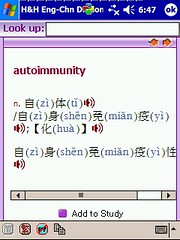
So can you say "autoimmunity" in Mandarin? ;)
H&H E-C dictionary is for the PPC platform. I have to admit, the speech is very clear and it sounds pretty natural. The closest Palm equivalent that I am aware of is the Yinhan "talking" dictionary which I also purchased sometime ago but the clarity of speech is not as good as H&H's.
So can you say "autoimmunity" in Mandarin? ;)
H&H E-C dictionary is for the PPC platform. I have to admit, the speech is very clear and it sounds pretty natural. The closest Palm equivalent that I am aware of is the Yinhan "talking" dictionary which I also purchased sometime ago but the clarity of speech is not as good as H&H's.
New StyleTap version supports Palm Treo 700w
For those new owners of the Palm Treo 700w which runs on Windows Mobile 5, the good news is you can run Palm PDA applications with Styletap which now supports the 700w
Read more in PIC
There are lots of great medical apps for PalmOS which are not found on the WM5 platform so Styletap will be a boon for WM5 users. Some notable examples are Medcalc and the Statcoder applications.
I would be curious to see how well these apps run on 240x240 though - appreciate any feedback from 700w users.
Read more in PIC
There are lots of great medical apps for PalmOS which are not found on the WM5 platform so Styletap will be a boon for WM5 users. Some notable examples are Medcalc and the Statcoder applications.
I would be curious to see how well these apps run on 240x240 though - appreciate any feedback from 700w users.
Dr. Companion releases B.N.F. and other apps
(via Ectopic Brain) Dr. Companion has a slew of PDA apps which should interest UK and UK trained doctors:
Titles include:
BNF (yes, so it's no longer "hypothetical")
Medicines Compendium
Cochrane abstracts (but you already know how to get these on your PDA for free)
Clinical Evidence (from BMJ Publishing Group)
Interactions
Oxford Handbooks
DSM IV
ICD 10
and lots more...
yes, jolly good show too, I must add ;)
Titles include:
BNF (yes, so it's no longer "hypothetical")
Medicines Compendium
Cochrane abstracts (but you already know how to get these on your PDA for free)
Clinical Evidence (from BMJ Publishing Group)
Interactions
Oxford Handbooks
DSM IV
ICD 10
and lots more...
yes, jolly good show too, I must add ;)
Wednesday, February 08, 2006
Epocrates Announces Free Integration with EMR and Other Healthcare IT Developers
Press release:
San Mateo, Calif., February 8, 2006 - Epocrates announced today that its widely adopted mobile and web-based clinical applications can now be linked to products developed by healthcare information system (HIS) partners. The Epocrates Linx™ Partner Program enables developers of mobile and desktop health information solutions, such as electronic medical records (EMRs) and ePrescribing applications, to integrate their systems and data with Epocrates solutions.
"With national and local initiatives underway to encourage adoption of EMRs and other healthcare information technologies, this announcement could not come at a better time," said John Halamka, MD, CIO of Harvard Medical School. "The ability to integrate Epocrates trusted products with new applications will help clinicians become more comfortable and open to incorporating more technology into their daily practice."
The incorporation of Epocrates solutions with EMRs and other HIS technologies promises to assist physicians in providing better patient care. In a recent survey of Epocrates customers, more than 75 percent of physicians reported they are more likely to use an EMR system if it is coupled with Epocrates' clinical applications. In addition, more than 90 percent believe they can make more informed and confident decisions with the integrated solution.
Epocrates currently partners with multiple healthcare IT developers of hospital-based, ambulatory care and multi-environment solutions. Epocrates' collaboration with partners such as, Allscripts, DrFirst, InstantDx, MercuryMD, PatientKeeper and SOAPware, increases interoperability among technologies and offers clinicians one convenient location for patient and clinical information via mobile devices or Internet connection.
"Since its inception, Epocrates has been the leading developer of clinical reference solutions proving that clinicians will enthusiastically embrace technology that assists in the improvement of patient safety and care on a daily basis. By working with Epocrates, we have found that our systems are becoming more valuable and viable during physician-patient interactions," said Randall Oates, MD, President, SOAPware, Inc.
Epocrates Linx allows HIS vendors to download the Epocrates application program interface (API) to create a customized user interface within their system. Vendors have the ability to embed hyperlinks within their HIS systems that will lead users directly to the relevant information in Epocrates' reference applications, increasing efficiency and convenience for clinicians. This seamless integration allows clinicians to move from one application to another, allowing them to review a patient record and then immediately access Epocrates' clinical information, including dosing, drug interactions, pricing, health plan coverage, and more.
"The marriage of our popular applications and our partners' real-time patient data enables clinicians to access critical information - from potential drug side effects to patient vaccination history - seamlessly and instantaneously," said Kirk Loevner, chairman and chief executive officer for Epocrates. "By working with current and future partners to connect our applications, we are supporting the needs of our customers and helping improve care for their patients."
Epocrates mobile and Internet-based products, including Epocrates Rx® and Epocrates® Online free drug and formulary applications, are used by more than 500,000 healthcare professionals. To learn more about the Epocrates and the Linx Partner Program, visit http://www2.epocrates.com/services/integration.
San Mateo, Calif., February 8, 2006 - Epocrates announced today that its widely adopted mobile and web-based clinical applications can now be linked to products developed by healthcare information system (HIS) partners. The Epocrates Linx™ Partner Program enables developers of mobile and desktop health information solutions, such as electronic medical records (EMRs) and ePrescribing applications, to integrate their systems and data with Epocrates solutions.
"With national and local initiatives underway to encourage adoption of EMRs and other healthcare information technologies, this announcement could not come at a better time," said John Halamka, MD, CIO of Harvard Medical School. "The ability to integrate Epocrates trusted products with new applications will help clinicians become more comfortable and open to incorporating more technology into their daily practice."
The incorporation of Epocrates solutions with EMRs and other HIS technologies promises to assist physicians in providing better patient care. In a recent survey of Epocrates customers, more than 75 percent of physicians reported they are more likely to use an EMR system if it is coupled with Epocrates' clinical applications. In addition, more than 90 percent believe they can make more informed and confident decisions with the integrated solution.
Epocrates currently partners with multiple healthcare IT developers of hospital-based, ambulatory care and multi-environment solutions. Epocrates' collaboration with partners such as, Allscripts, DrFirst, InstantDx, MercuryMD, PatientKeeper and SOAPware, increases interoperability among technologies and offers clinicians one convenient location for patient and clinical information via mobile devices or Internet connection.
"Since its inception, Epocrates has been the leading developer of clinical reference solutions proving that clinicians will enthusiastically embrace technology that assists in the improvement of patient safety and care on a daily basis. By working with Epocrates, we have found that our systems are becoming more valuable and viable during physician-patient interactions," said Randall Oates, MD, President, SOAPware, Inc.
Epocrates Linx allows HIS vendors to download the Epocrates application program interface (API) to create a customized user interface within their system. Vendors have the ability to embed hyperlinks within their HIS systems that will lead users directly to the relevant information in Epocrates' reference applications, increasing efficiency and convenience for clinicians. This seamless integration allows clinicians to move from one application to another, allowing them to review a patient record and then immediately access Epocrates' clinical information, including dosing, drug interactions, pricing, health plan coverage, and more.
"The marriage of our popular applications and our partners' real-time patient data enables clinicians to access critical information - from potential drug side effects to patient vaccination history - seamlessly and instantaneously," said Kirk Loevner, chairman and chief executive officer for Epocrates. "By working with current and future partners to connect our applications, we are supporting the needs of our customers and helping improve care for their patients."
Epocrates mobile and Internet-based products, including Epocrates Rx® and Epocrates® Online free drug and formulary applications, are used by more than 500,000 healthcare professionals. To learn more about the Epocrates and the Linx Partner Program, visit http://www2.epocrates.com/services/integration.
Just The Facts In Emergency Medicine
USBMIS is having a special offer on Just The Facts In Emergency Medicine
The special offer valid till Feb 12th is a $10 discount off the regular price
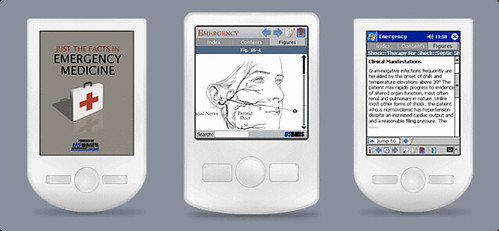 Just The Facts In Emergency Medicine, PDA Edition is the perfect tool to prepare for in-service or licensing exams, for recertification, or for use as a clinical refresher. Features include: * Effectively condenses Tintinalli's Emergency Medicine, 5, for a concise, yet comprehensive review. * Standardized, bulleted format stresses key points of epidemiology, pathophysiology, clinical features, diagnosis and differential, and ED care and disposition. * At-a-glance use of prioritized and numbered treatments, quick-reference tables, and key figures assure quick absorption of the material. * Includes special sections that review the various written exams and provide test-taking tips and strategies. * Provides state-of-the art information on antiplatelet agents, pain management, stroke management, new treatments for viral disorders, and more. |
The special offer valid till Feb 12th is a $10 discount off the regular price
eMedicine series in your Palm
I mentioned in Free Medical Books a great online resource for obtaining free medical texts and information.
I particularly like the eMedicine series which have well written reviews. The eMedicine terms of use allows you to download articles to your PDA for your personal use.
Just surf over to the eMedicine TOC and select the topic of your choice. In my case I selected eMedicine Hematology
My preferred reader is iSilo so I'll use this an example.
You can use iSiloX to fetch the links (set it to link depth 1 and restrict it to the emedicine.com domain) .
The end product is quite readable on the Palm but I had to set iSilo to "no tables" to avoid having to scroll left and right when reading the articles.
Here is a composite view of several screenshots:
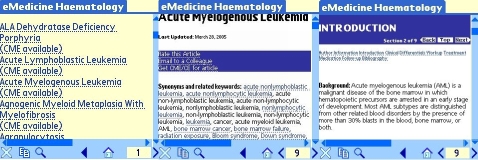
Another popular reader is Plucker. This one is free and works just as well as iSilo. If you want an application to fetch the pages and convert it to Plucker format, I would recommend you use Sunrise XP which is also freeware.
Happy reading! Any other favorite medical ebooks sites to share?
I particularly like the eMedicine series which have well written reviews. The eMedicine terms of use allows you to download articles to your PDA for your personal use.
Just surf over to the eMedicine TOC and select the topic of your choice. In my case I selected eMedicine Hematology
My preferred reader is iSilo so I'll use this an example.
You can use iSiloX to fetch the links (set it to link depth 1 and restrict it to the emedicine.com domain) .
The end product is quite readable on the Palm but I had to set iSilo to "no tables" to avoid having to scroll left and right when reading the articles.
Here is a composite view of several screenshots:
Another popular reader is Plucker. This one is free and works just as well as iSilo. If you want an application to fetch the pages and convert it to Plucker format, I would recommend you use Sunrise XP which is also freeware.
Happy reading! Any other favorite medical ebooks sites to share?
Monday, February 06, 2006
Convergence - the way forward?
I mean convergence as far as PDA Medical software is concerned. As for PDA hardware, we are already seeing convergence in PDAphones or smartphones being more popular than pure PDAs nowadays.
I am seeing a trend whereby publishers are packaging diagnostic/clinical information/drug information software as integrated bundles for PDAs. Is this a good thing? Yes I think so as it would appeal to doctors who may not have an idea where to begin to get the software on an individual basis. It's also a good thing as generally speaking integrated software would work better together rather than individual standalone applications. Something like your Hifi system I guess. Bundles are also generally cheaper than purchasing the apps individually.
On the other hand, you are tied down to an individual publisher and hence that publisher's strengths and weaknesses. You don't get to mix your own.
On a related note, there's yet another survey by Skyscape which has found (surprise, surprise) that Mobile Handheld Technology Empowers Medical Providers to Deliver Better and More Efficient Care While Reducing Errors:
MARLBOROUGH, MASS. – Feb. 6, 2006 – Physicians and others who use PDAs, Smartphones, and related medical decision support tools say they’re providing better and more efficient patient care as a result, according to a new survey of 2,800 medical professionals conducted by Skyscape, Inc.
In the research, a majority of medical professionals surveyed cited mobile handheld technology and related software titles and tools as “critical” to their daily practice – and reported that the solutions enabled them to reduce potential medical errors, provide greater medical care, and assist more patients, according to John Ryder, Vice President, of Skyscape, Inc.
An overwhelming 84 percent of the medical professionals surveyed reported that their personal use of PDAs and medical-related reference titles and decision software resulted in a decrease of potential medical errors, he said.
Even more, 88 percent, said they increased efficiencies in their practice through the use of the technology, with 72 percent reporting being able to provide more care in less time.
PDAs, however, are no longer just a tool of the individual physician, Ryder noted. Hospitals and educational institutions are deploying or otherwise supporting the use of handheld decision support software by doctors as well as nurses, medical students and instructors.
While 50% of US physicians are already using handheld devices, usage should continue to grow as new applications are customized to the technology, he said. As a tool in their daily practice, 70% of medical professionals in the Skyscape survey called their use of PDAs either “Important or “Critical.”
“Meanwhile, the 800-pound gorilla in the equation is the coming ‘convergence’ of a variety of currently stand-alone e-applications,” Ryder said.
In the Skyscape survey, medical professionals cited the access of drug, clinical, and drug interaction references, along with organizational information such as treatment guidelines, as their current, chief PDA-based applications.
“Expect the growth in handheld technology to be driven by a growing trend in evidence-based medicine, daily (if not hourly) updates in reference databases, and increased wireless accessibility,” Ryder said. “Combine this on-going ‘information barrage’ with the coming convergence of EMR (e-medical records) and e-prescribing on handheld devices – and we’ll see more medical professionals using PDAs more often and for more uses.”
“But more importantly, patients are welcoming the increased speed and accuracy of medical care – as well as the greater attention and overall confidence by their caregivers that handheld technology is helping to provide at the point-of-care,” Ryder said. “The bottom line is that continuing evolution of mobile handheld technology and decision support tools is resulting in better medicine.”
I am seeing a trend whereby publishers are packaging diagnostic/clinical information/drug information software as integrated bundles for PDAs. Is this a good thing? Yes I think so as it would appeal to doctors who may not have an idea where to begin to get the software on an individual basis. It's also a good thing as generally speaking integrated software would work better together rather than individual standalone applications. Something like your Hifi system I guess. Bundles are also generally cheaper than purchasing the apps individually.
On the other hand, you are tied down to an individual publisher and hence that publisher's strengths and weaknesses. You don't get to mix your own.
On a related note, there's yet another survey by Skyscape which has found (surprise, surprise) that Mobile Handheld Technology Empowers Medical Providers to Deliver Better and More Efficient Care While Reducing Errors:
MARLBOROUGH, MASS. – Feb. 6, 2006 – Physicians and others who use PDAs, Smartphones, and related medical decision support tools say they’re providing better and more efficient patient care as a result, according to a new survey of 2,800 medical professionals conducted by Skyscape, Inc.
In the research, a majority of medical professionals surveyed cited mobile handheld technology and related software titles and tools as “critical” to their daily practice – and reported that the solutions enabled them to reduce potential medical errors, provide greater medical care, and assist more patients, according to John Ryder, Vice President, of Skyscape, Inc.
An overwhelming 84 percent of the medical professionals surveyed reported that their personal use of PDAs and medical-related reference titles and decision software resulted in a decrease of potential medical errors, he said.
Even more, 88 percent, said they increased efficiencies in their practice through the use of the technology, with 72 percent reporting being able to provide more care in less time.
PDAs, however, are no longer just a tool of the individual physician, Ryder noted. Hospitals and educational institutions are deploying or otherwise supporting the use of handheld decision support software by doctors as well as nurses, medical students and instructors.
While 50% of US physicians are already using handheld devices, usage should continue to grow as new applications are customized to the technology, he said. As a tool in their daily practice, 70% of medical professionals in the Skyscape survey called their use of PDAs either “Important or “Critical.”
“Meanwhile, the 800-pound gorilla in the equation is the coming ‘convergence’ of a variety of currently stand-alone e-applications,” Ryder said.
In the Skyscape survey, medical professionals cited the access of drug, clinical, and drug interaction references, along with organizational information such as treatment guidelines, as their current, chief PDA-based applications.
“Expect the growth in handheld technology to be driven by a growing trend in evidence-based medicine, daily (if not hourly) updates in reference databases, and increased wireless accessibility,” Ryder said. “Combine this on-going ‘information barrage’ with the coming convergence of EMR (e-medical records) and e-prescribing on handheld devices – and we’ll see more medical professionals using PDAs more often and for more uses.”
“But more importantly, patients are welcoming the increased speed and accuracy of medical care – as well as the greater attention and overall confidence by their caregivers that handheld technology is helping to provide at the point-of-care,” Ryder said. “The bottom line is that continuing evolution of mobile handheld technology and decision support tools is resulting in better medicine.”
Saturday, February 04, 2006
B.N.F. revisited (part two)
The B.N.F. (bnf.org) is a free (but registration required) site for doctors to access drug information. It is widely used in the UK and some other countries. It is somewhat short on some drug info like mechanism of action but it has the essentials and the preamble in each drug section is quite useful.
Anyway continuing with the B.N.F. story.... I believe there have been some who have "cached" the B.N.F. and converted the pages into iSilo format for "offline" viewing. Is this acceptable? I don't think the B.N.F. folks would agree to it.
The B.N.F. website, although stating that "Users may view, use, reproduce or store copies of Publishers’ Material without seeking permission provided it is for non-commercial personal or professional use; or it is for non-commercial research, private study or in a non-commercial document with limited circulation", also states that "downloading a substantial amount of the Publishers’ Material onto any digital device for ‘off-line’ use is not within the Permitted Purposes".
So folks, no, it is not within the B.N.F.'s terms of use to create an iSilo document - pity. Anyway the B.N.F. has put in place an electronic mechanism to prevent wholesale downloading of their website so it would be difficult to do this.
What if this were possible? I don't really know so don't ask me how, what, where etc.
The following is just a hypothetical example of what the B.N.F. would look like if it were possible:
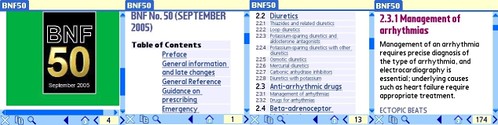
The hypothetical size of such an iSilo document is said to be about 8.7MB.
Would such an iSilo document be useful it were available? Yes, it would help those with PalmPDAs without any wireless or Wifi capabilities.
I believe however accessing the B.N.F. website directly from a wireless capable PDA (as mentioned in B.N.F. revisited (part one) ) is still the better option because there is the Search function which works very well. The search field will also take multiple drugs for checking drug interaction. A static B.N.F. isilo document will not permit such features. It is also cumbersome to use iSilo's search mechanism for such a large document.
Addendum:
BM has pointed out that you can actually purchase the BNF for PDA - this is goood news if you really want a full fledged PDA version (since the hypothetical example above doesn't really exist). You can get it from http://www.pharmpress.com/bnfpda
Anyway continuing with the B.N.F. story.... I believe there have been some who have "cached" the B.N.F. and converted the pages into iSilo format for "offline" viewing. Is this acceptable? I don't think the B.N.F. folks would agree to it.
The B.N.F. website, although stating that "Users may view, use, reproduce or store copies of Publishers’ Material without seeking permission provided it is for non-commercial personal or professional use; or it is for non-commercial research, private study or in a non-commercial document with limited circulation", also states that "downloading a substantial amount of the Publishers’ Material onto any digital device for ‘off-line’ use is not within the Permitted Purposes".
So folks, no, it is not within the B.N.F.'s terms of use to create an iSilo document - pity. Anyway the B.N.F. has put in place an electronic mechanism to prevent wholesale downloading of their website so it would be difficult to do this.
What if this were possible? I don't really know so don't ask me how, what, where etc.
The following is just a hypothetical example of what the B.N.F. would look like if it were possible:
The hypothetical size of such an iSilo document is said to be about 8.7MB.
Would such an iSilo document be useful it were available? Yes, it would help those with PalmPDAs without any wireless or Wifi capabilities.
I believe however accessing the B.N.F. website directly from a wireless capable PDA (as mentioned in B.N.F. revisited (part one) ) is still the better option because there is the Search function which works very well. The search field will also take multiple drugs for checking drug interaction. A static B.N.F. isilo document will not permit such features. It is also cumbersome to use iSilo's search mechanism for such a large document.
Addendum:
BM has pointed out that you can actually purchase the BNF for PDA - this is goood news if you really want a full fledged PDA version (since the hypothetical example above doesn't really exist). You can get it from http://www.pharmpress.com/bnfpda
Cochrane reviews in your Palm - for free
I did mention back in December 2005 that you can get a special PDA version of the Cochrane database of systematic reviews. I notice that Medgadget has mentioned this again in Cochrane Reviews - Evidence-Based Medicine At the Bedside. While convenient, I realise that the price is not exactly a bargain - you have to purchase each topic individually!
Well, there is a free alternative.
1) Access the Cochrane Library with your browser
2) Use the Search function in the upper right of the page to locate the paper you want
3) Save a PDF copy
4) Use PalmPDF to read it in your Palm
Simple isn't it?
Digg Story
Well, there is a free alternative.
1) Access the Cochrane Library with your browser
2) Use the Search function in the upper right of the page to locate the paper you want
3) Save a PDF copy
4) Use PalmPDF to read it in your Palm
Simple isn't it?
Digg Story
Subscribe to:
Posts (Atom)